Woeken Is Everywhere Online — But Its Real Meaning Is More Complicated Than the Viral Claims
Search results are giving "Woeken" several confident definitions, yet the strongest linguistic evidence tells a very different story.

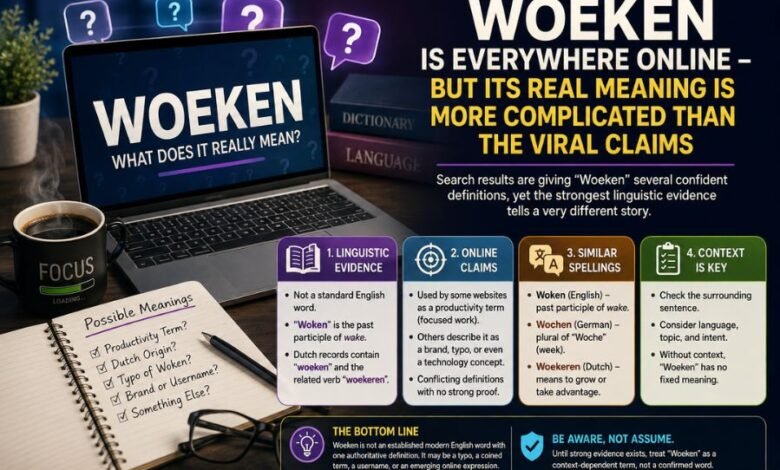
Search for Woeken in 2026, and the results become confusing almost immediately. One page describes it as a new productivity term for intense concentration. Another presents it as an internet-born expression. Elsewhere, it is treated as a typo, a brand-style word, or even a technology concept.
The problem is not a shortage of explanations. It is the shortage of verifiable evidence behind those explanations. Recent articles repeatedly attach new meanings to Woeken, yet established English dictionaries do not recognize it as a standard English word. Cambridge and Merriam-Webster instead document “woken” as the past participle of “wake”.
There is another twist. The spelling is not completely without linguistic history. Dutch historical dictionary material contains woeken in older records, while modern Dutch recognizes the related verb woekeren. That makes the truth much more interesting than simply declaring Woeken a newly invented piece of internet slang.
BLUF: Woeken is not an established modern English word with one authoritative definition. In current English-language search results, it can represent a typo, a coined label, a username, or a recently assigned internet meaning. Historical Dutch records also contain the spelling, so the strongest available evidence does not support treating Woeken exclusively as newly created productivity slang.
The Productivity Definition Has a Verification Problem
One of the most repeated explanations for 2026 says Woeken means a state of concentrated, distraction-free work.
That definition sounds plausible. It also fits neatly beside familiar concepts such as deep work, flow, study sessions, and digital detoxing. Several recently published websites describe Woeken in roughly those terms. One August 2026 article calls it a focused stretch of work, while another 2026 explainer similarly associates it with distraction-free concentration.
But repetition should not be mistaken for linguistic proof.
A genuine emerging slang term usually leaves evidence beyond SEO explainers: identifiable communities using it naturally, dated social posts, corpus examples, dictionaries tracking its development, or a traceable creator or subculture. The available evidence reviewed here does not establish such a chain for Woeken.
The uncertainty becomes even more obvious because competing pages assign entirely different meanings. One 2026 article describes Woeken as a system for turning written prompts into AI-generated video, a claim that conflicts sharply with the productivity interpretation.
That contradiction matters.
Editorial assessment: when multiple recent pages confidently give the same unfamiliar spelling unrelated definitions, readers should verify the word independently rather than assuming search-result repetition proves a new cultural phenomenon.
Before Calling It New Slang, Look at the Dutch Record
Woeken becomes more interesting when historical language sources enter the picture.
The Instituut voor de Nederlandse Taal maintains major historical Dutch dictionaries. Its Middle Dutch dictionary entry for woekeren discusses older forms including woukeren and wokeren and specifically notes an occurrence of woeken in historical material. The entry connects this word family with activities involving interest or usury.
Modern Dutch uses woekeren, not Woeken, as an ordinary equivalent English speakers should casually adopt. The official Dutch word-list search shows forms such as woeker, woekert, woekeren, and gewoekerd.
The broader meanings associated with woekeren have developed beyond money. Dutch references can use it for aggressive or uncontrolled growth and for extracting maximum use or advantage from limited resources. That semantic history could make later associations with intense productivity seem tempting—but similarity is not evidence that modern English “Woeken” directly evolved from that sense.
There is another historical complication. Early Middle Dutch corpus material also shows the spelling woeken in phrases involving periods of weeks, demonstrating why matching letter sequences across centuries cannot automatically be treated as a single continuous word with a single meaning.
Woken, Wochen and Woekeren: Four Spellings That Should Not Be Blended
Confusion around the keyword partly stems from several genuine words that differ by only one or two letters.
Woken
Woken is an English verb form. Cambridge identifies it as the past participle of wake, while Merriam-Webster gives the same grammatical definition.
Correct example: She had woken before the alarm.
If “woeken” appears in an English sentence about waking from sleep, woken is therefore the most likely intended word.
Wochen
Wochen is German, not English. Duden lists Woche as the German noun for a seven-day week and gives Wochen as its plural form.
Someone encountering Woeken in a multilingual document could therefore be looking at a typing error involving German Wochen.
Woekeren
Woekeren is an established Dutch verb. Its historical and modern records carry meanings connected with growth, taking maximum advantage of something, and, historically, usury or lending at interest.
Woeken
Woeken requires context. In contemporary English material, it does not currently have the same standardized status as woken, German Wochen, or Dutch woekeren.
How a Search Keyword Can Start Looking Like a Real Word
The internet can amplify uncertainty surprisingly quickly.
A strange spelling appears. People search it. Publishers notice the queries. Explainer pages appear. Other publishers examine those pages and publish similar explanations. Once enough pages exist, the search results themselves can create the impression that the term is already established.
Woeken offers a useful case study because recent articles do not merely explain an ambiguous keyword—they sometimes construct very specific interpretations around it.
That does not automatically make those interpretations fraudulent. Language genuinely can develop online. A coined word may eventually become normal if communities consistently use it and readers understand the shared meaning.
The critical distinction is established usage versus proposed usage.
As of September 2026, it is safer to write that some online sources use Woeken to describe focused work than to state that Woeken officially means deep work.
A Practical Context Test for Anyone Who Encounters “Woeken”
Use the surrounding sentence before deciding what the word means.
- Sleep or waking context: check whether the intended word is woken.
- German time or scheduling context: check whether it should be Wochen.
- Dutch text: investigate woekeren, woeker, or historical usage.
- Username or company context: Woeken may be a deliberately invented proper name.
- Productivity post: it may be using the recently promoted “focused work” interpretation.
- Technology page: verify the actual product before assuming Woeken names a recognized platform or tool.
- No clear context: do not assign it a definitive meaning.
That approach is more reliable than selecting the first definition.
This timeline does not prove that one recent publisher created the term. It shows why claims of a single confirmed modern origin should be treated cautiously.
FAQs.
What does Woeken mean?
Woeken is an ambiguous term, not a standardized modern English word. Depending on the context, it may be a misspelling of “woken,” a deliberately coined name, a reference influenced by another language, or a recently coined internet expression. Some 2026 websites associate it with focused work, but authoritative linguistic sources have not yet firmly established that meaning.
Is Woeken a real English word?
Woeken is not currently established as a standard English dictionary word. Major references such as Cambridge and Merriam-Webster list “woken” as the past participle of “wake.” That doesn’t prevent people from using Woeken creatively, but a coined or informal expression shouldn’t be presented as standard English without stronger evidence.
Does Woeken mean deep work or intense concentration?
Woeken is sometimes used online to mean focused or distraction-free work, particularly in recent explainer articles. The limitation is evidentiary: those pages do not establish a widely recognized linguistic origin or clearly documented community adoption. The definition of productivity is therefore best described as an emerging interpretation rather than a settled meaning.
Is Woeken a Dutch word?
Woeken has historical Dutch evidence, but modern usage requires careful distinction. The Instituut voor de Nederlandse Taal records the spelling of woekeren in historical material. Modern standard Dutch uses forms of woekeren, so readers should not simply translate contemporary English uses of Woeken as if they were identical to the established Dutch verb.
Is Woeken the same as Woken?
Woeken and woken should not be treated as the same spelling. Woken is established English and means the past participle of wake. If Woeken appears in a sentence about someone becoming awake, it is likely a typo for woken, but brand names and deliberately coined uses may be intentional.
Why is Woeken appearing in so many search results?
Woeken attracts searches because its meaning is unclear, and that uncertainty creates demand for explanations. Recent publishers have responded with competing interpretations involving productivity, branding, language, and technology. Search visibility alone cannot establish which interpretation—if any—will become a durable meaning.
The Most Accurate Way to Understand Woeken in 2026
Woeken reminds us that search visibility and linguistic authority are different.
The term unquestionably exists online. People publish about it, search for it, and assign meanings to it. What remains unproven is a universally accepted modern English definition.
The evidence supports a narrower answer: Woeken is currently context-dependent. It can represent an error, a coined identifier, or emerging informal usage, while the same spelling also has historical Dutch evidence predating its recent internet attention.
If a stable modern meaning eventually develops, sustained real-world usage will make that clearer. Until then, the most trustworthy explanation is not the most dramatic one—it is the one that clearly separates documented language history from recent online interpretation.
Editorial Disclaimer
This article distinguishes established dictionary evidence from emerging online interpretations. Internet terminology can change quickly, and a currently non-standard expression may acquire broader accepted usage later. Claims about Woeken being established slang, a specific technology, or a formally defined productivity concept should therefore be independently verified before being presented as fact.