AmCoder: What the Software-Engineering Learning Platform Actually Teaches and Why Its Structured Path Stands Out
AmCoder is positioning itself around a simple idea: aspiring software engineers may need a coherent mental map more than another disconnected collection of coding tutorials.

Learning programming is no longer difficult because information is scarce. The opposite is true. Students can find thousands of videos on JavaScript, data structures, artificial intelligence, databases, Git, system design, and interview preparation. The harder problem is knowing what belongs first, what connects to what, and when a learner is ready to move forward.
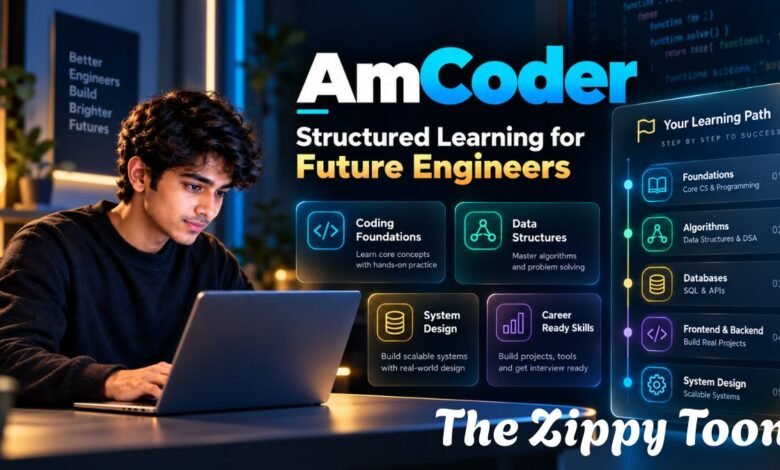
That is the problem AmCoder says it wants to address. Its public website presents the platform as a structured route toward software engineering rather than a rapid crash course built around memorizing frameworks or interview answers. The published learning path moves from computer-science foundations into algorithms, data structures, databases, APIs, frontend and backend development, system design, and collaboration tools.
There is also an important search issue around the name itself. “AmCoder,” “AmCodr,” “AmcoderZ,” and “AmCoder Technologies” are associated with different organizations. The education-focused AmCoder discussed here is the platform operating at AmCoder.in and describing its mission around accessible coding education for engineering talent in India.
BLUF: AmCoder is an India-focused software-engineering learning platform built around structured understanding rather than isolated coding lessons. Its published roadmap connects computer-science foundations, problem solving, data structures, databases, frontend and backend development, system design, Git, GitHub, Jira, and Figma into one progressive engineering-learning path.
The AmCoder Identity Starts With a Structured Engineering Roadmap
The strongest distinguishing feature visible on AmCoder’s public website is not a particular programming language. It is sequencing.
AmCoder describes the learning process as a journey toward becoming a software engineer. Instead of immediately pushing students toward a framework, its roadmap starts by explaining how computing developed, what computation means, how hardware and software became separated, why operating systems exist, and how instructions, memory, and processes interact.
That foundation matters because modern developers often use abstractions without understanding what happens beneath them. A beginner can learn how to call an API before understanding a request-response model. Someone can write SQL before understanding relational data structures. A developer can install a caching library without knowing what problem caching is supposed to solve.
Why AmCoder Does Not Begin With “Learn This Framework Fast”
Many coding platforms are organized around technologies: learn Python, learn React, learn Node.js, learn SQL.
AmCoder’s publicly described approach is broader. It begins with the mechanics and logic of computing before moving into software construction. That creates a distinction between learning syntax and learning engineering.
A programming language gives developers a way to express instructions. Software engineering requires considerably more: breaking problems into manageable units, selecting data structures, understanding storage, designing interfaces between systems, handling failure, maintaining code, and working with other developers.
AmCoder explicitly includes those layers in its roadmap.
From Algorithms to Engineering Decisions
The problem-solving phase includes algorithms and data structures such as arrays, stacks, queues, trees, and graphs. The platform also highlights time and space considerations, placing computational efficiency alongside basic coding ability.
This matters because data structures are often taught as separate academic topics. A more useful engineering question is why a particular structure exists and when its properties make it appropriate.
An array, queue, and tree are not interchangeable textbook definitions. They represent different ways of organizing information around different operational needs.
AmCoder’s stated philosophy emphasizes understanding those reasons rather than treating data structures as a checklist.
A useful way to read the AmCoder model is this: the platform is not simply asking, “Can you write code?” It pushes learners toward the harder question: “Can you explain why the software works this way?”
Inside the AmCoder Learning Stack: From Memory to Distributed-System Thinking
The published curriculum becomes more practical once learners move beyond foundations and problem solving.
AmCoder identifies memory versus disk storage, relational databases, schemas, SQL, APIs, backend fundamentals, and system failure as part of its engineering core. It then moves toward browser behavior, JavaScript, frontend architecture, application state, backend communication, and the connection between interfaces, services, and stored data.
That sequence mirrors an important reality of software development: applications are systems of interacting components.
A web page is not merely HTML on a screen. A modern product can involve a browser, frontend code, authentication, APIs, backend services, databases, caches, external services, and infrastructure handling traffic.
AmCoder’s curriculum makes those relationships visible instead of teaching every layer as an unrelated skill.
System Design Is Where AmCoder Tries to Move Learners Beyond “Coder”
System design is one of the more notable components of AmCoder’s public roadmap.
The platform separates low-level and high-level design thinking. It introduces concepts such as responsibilities, boundaries, scale, traffic, failure, caching, and load balancing.
Why Caching and Load Balancing Matter
Caching exists because repeatedly doing expensive work wastes time and computing resources. You can store frequently requested information temporarily so future requests can be answered more efficiently.
Load balancing addresses a different issue: distributing incoming work across computing resources rather than forcing a single server or service instance to handle everything.
A learner who knows how to create a website but cannot reason about increased traffic has learned development at one level. A learner who begins asking what happens when requests multiply, databases slow down, or services fail has started moving toward system-level engineering.
AmCoder explicitly makes that shift part of its educational direction.
GitHub, Jira and Figma Reveal AmCoder’s Workplace-Oriented Side
Another revealing part of AmCoder’s curriculum appears near the engineering-toolkit stage.
The platform names Git and GitHub, Jira and Figma alongside reading other people’s code and communicating technical ideas.
These are not programming languages. Their presence indicates that the roadmap treats software engineering as collaborative work.
Git provides version-control capabilities. GitHub is widely used to host and collaborate on software repositories. Jira is commonly used to plan and track development work, while Figma is used heavily for interface and product design workflows.
The deeper lesson is that production software usually involves more than one person.
Reading Existing Code Can Matter More Than Starting From Zero
Beginner tutorials often ask students to build small projects from scratch. Professional developers frequently face the opposite situation: they enter an existing codebase written by other people.
Understanding unfamiliar code, tracing dependencies, recognizing architectural decisions, and making changes without introducing regressions are valuable engineering skills.
AmCoder explicitly identifies confidence in reading other people’s code as part of its pathway.
That detail gives the roadmap a more workplace-oriented character than a curriculum based purely on coding exercises.
The Biggest Information Gaps Students Should Notice Before Committing
AmCoder’s public learning philosophy is relatively clear. However, several practical details are not clearly established in the publicly indexed material reviewed for this article.
The material reviewed does not provide enough authoritative information to confidently state a standard program price, fixed course duration, certification value, accreditation status, instructor roster, placement rate, or guaranteed employment outcome.
Those omissions matter.
Students evaluating any learning platform should separate a curriculum outline’s quality from commercial claims about career results.
A strong roadmap can explain what someone should study. It does not automatically prove how effectively individual students will learn it, how instructors support them, or what employment outcomes participants achieve.
For AmCoder specifically, readers should verify current enrollment terms, access model, support arrangements, pricing, and any certification or placement claims directly through current official information before making a financial commitment.
Do Not Confuse AmCoder With AmCodr, AmcoderZ or AmCoder Technologies
Search ambiguity is unusually important for this keyword.
The education-focused AmCoder at AmCoder.in describes itself around a pathway to software engineering and coding education for India’s engineering talent.
AmCodr IT Solutions Pvt. Ltd., by contrast, describes itself as an Ahmedabad-based software development and IT services company established in 2016. Its official material lists web applications, mobile applications, and website development among its services.
AmcoderZ Infotech is another separate organization. Its official website describes custom software, mobile applications, web development, healthcare applications, BLE and IoT integrations.
AmCoder Technologies also appears to be a privately held software-development company headquartered in Monterrey, Mexico.
FAQs.
What is AmCoder?
AmCoder is a software-engineering learning platform that presents a structured pathway from computer-science foundations through algorithms, data structures, databases, APIs, frontend and backend development, system design and engineering collaboration tools. Its public positioning emphasizes understanding concepts before relying on memorization.
Is AmCoder a coding course or a software company?
The AmCoder discussed at AmCoder.in is education-focused, not the similarly named software-service businesses found in search results. AmCodr IT Solutions, AmcoderZ Infotech, and AmCoder Technologies are separate organizations with different services and identities.
What does AmCoder teach beginners?
AmCoder teaches beginners through a layered path covering computing fundamentals, operating systems, memory, algorithms, data structures, SQL, relational databases, APIs, backend concepts, browsers, JavaScript, frontend architecture, and system design. Git, GitHub, Jira, Figma, and communication also appear in its engineering toolkit.
Does AmCoder teach system design?
Yes. AmCoder’s published roadmap includes both low-level and high-level system design. It specifically references responsibilities, boundaries, scaling, traffic, failures, caching, and load balancers, indicating that system-level reasoning is intended to follow its programming and application-development foundations.
Is AmCoder suitable for software-engineering interview preparation?
AmCoder presents interview confidence as one outcome of understanding software-engineering concepts, but its public message does not frame the program merely as an interview-question bank. Its roadmap instead emphasizes foundational understanding, algorithms, architecture, collaboration, and explaining engineering decisions.
Is AmCoder free, and does it provide certificates or placements?
Current publicly indexed information reviewed for this article does not provide enough authoritative detail to make a definitive statement about universal pricing, certification, accreditation, or placement guarantees. Prospective learners should verify those points through AmCoder’s current official enrollment information rather than relying on third-party descriptions.
Why AmCoder’s Real Value Proposition Is the Order of Learning
AmCoder’s most interesting idea is not a secret programming technique or a fashionable framework.
It is order.
Computer science comes before unthinkingly selecting technologies. Problem solving comes before copying solutions. Databases and APIs are connected to application architecture. Frontend and backend development lead toward system design. GitHub, Jira, Figma, and communication extend coding into collaborative engineering.
That structure addresses a genuine challenge for self-taught developers: knowing many terms without understanding how they connect.
AmCoder’s public roadmap therefore makes the strongest case for itself as a mental model for software engineering. Whether its delivery, support system, and future learner outcomes match the ambition of that roadmap will require continued verification as the platform publishes more information.
Editorial Verification Note
This article distinguishes AmCoder.in from similarly named technology businesses and relies on publicly accessible information available as of September 24, 2026. Do not assume pricing, enrollment terms, certification, accreditation, instructor information, or employment outcomes where authoritative public evidence is unavailable. Readers should confirm any commercial or career-related claims directly with the relevant organization before making decisions.