FancyAI Skills: Powerful AI Experts Transforming Business Automation and Creative Work

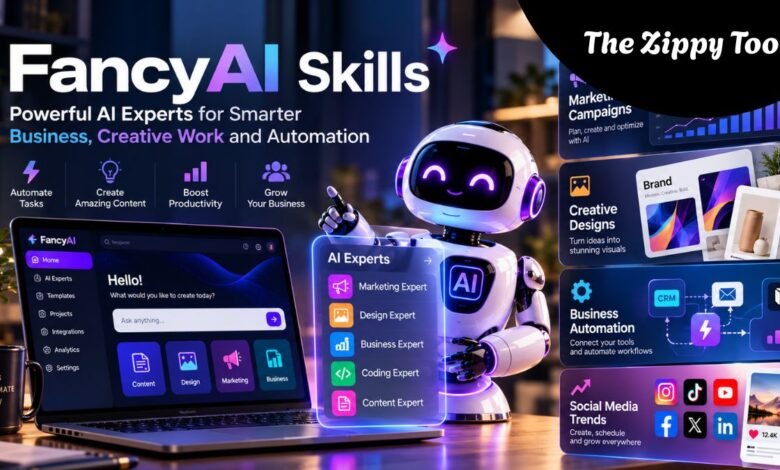
Artificial intelligence has become essential to modern business operations, helping companies manage demanding tasks, boost productivity, and develop creative solutions. Among the platforms exploring this transformation, FancyAI Skills offers a specialized approach to digital assistance and business automation. Rather than relying on general-purpose AI tools, the platform focuses on dedicated capabilities designed for specific professional responsibilities.
From digital marketing and content production to customer relationship management and product development, businesses increasingly need technology that supports multiple operations without adding unnecessary complexity. FancyAI approaches this challenge through specialized AI experts, workflow integrations, and creative tools intended to work alongside existing business systems.
Understanding these capabilities can help entrepreneurs, marketing professionals, designers, and growing organizations decide whether specialized AI fits their daily operations.
This article explores what FancyAI Skills are, how they work, their major features, practical applications, benefits, limitations, and future potential.
What Are FancyAI Skills?
FancyAI Skills are specialized artificial intelligence capabilities associated with the FancyAI platform. They are designed to support professional workflows involving business information, marketing activities, design production, and operational management.
Unlike traditional automation software that follows narrowly defined instructions, AI-powered skills can interpret requests and help with language-based tasks, creative decisions, and data analysis. Their usefulness depends on the information provided, the available integrations, and the level of human supervision.
The platform delivers these capabilities through specialized AI experts and a desktop environment that connects business systems to creative tools. This approach allows organizations to explore AI-assisted workflows instead of treating every task as an isolated activity.
For example, a marketing team might analyze customer information, prepare campaign materials, and create promotional variations through connected processes. The goal isn’t simply to generate content faster, but to make business execution more consistent and manageable.
How Do FancyAI Skills Work?
FancyAI combines AI-driven task execution with access to relevant business information. Users identify their objectives, choose a suitable capability or expert, and provide the context needed to perform the requested activity.
The platform describes integrations with systems used for customer relationships, enterprise resource planning, digital asset management, and advertising. These connections let different activities draw on shared business information instead of requiring employees to transfer data manually between unrelated applications.
Specialized AI Experts
One notable aspect of FancyAI is its emphasis on specialized AI agents. These digital assistants are presented around particular responsibilities, including design, operations, marketing, software development, and business organization.
A design-oriented expert may support visual content creation, while an operations-focused assistant may help examine sales performance or identify business trends. Technical experts are described as assisting with software requirements, architecture, and development tasks.
This separation of responsibilities makes it easier to choose AI assistance that matches the task, rather than relying on a single general-purpose system for everything.
Business System Integration
The desktop offering emphasizes connections with CRM, ERP, digital asset libraries, and social platforms. These integrations are intended to bring operational information and creative execution into a more connected workspace.
However, the actual functionality available to an organization may depend on its software environment, permissions, technical configuration, and selected services.
Key Features of FancyAI Skills
1. AI-Powered Content and Campaign Creation
Marketing teams regularly need advertisements, product descriptions, campaign concepts, and promotional material. FancyAI includes campaign-drafting capabilities to support these activities.
Users can use business context to develop creative briefs, ad variations, landing page sections, and marketing concepts. The potential advantage is greater consistency between business objectives and the content produced.
Although AI can accelerate drafting, human editors still need to review claims, tone, originality, and factual accuracy before publication.
2. Customer Relationship Management
Customer engagement is another important application. FancyAI describes CRM-related skills that can analyze customer behavior, identify possible retention concerns, and support personalized re-engagement campaigns.
For an online retailer, these capabilities could help marketing staff identify customer segments that need attention and prepare appropriate communications.
Customer data privacy remains essential. Organizations should ensure that any integration respects their data-handling policies, customer permissions, and applicable regulations.
3. Product Design and Visual Production
Creative businesses can benefit from technology that supports image production, design exploration, and the development of promotional assets.
FancyAI offers tools and expertise for product design, visual content, fashion imagery, and creative experimentation. Its published examples include transforming clothing images into model-based content and developing alternative product presentations.
These capabilities may be particularly relevant to fashion retailers, e-commerce companies, and creative agencies that require multiple visual concepts for different audiences.
However, AI-generated visual assets should be reviewed for product accuracy, realistic representation, intellectual property concerns, and advertising suitability.
4. Performance Marketing Assistance
Digital advertising requires continuous testing and refinement. Businesses often experiment with different headlines, visuals, messages, and promotional approaches to understand customer preferences.
FancyAI’s performance creative capabilities aim to turn successful advertising concepts and performance information into additional creative variations.
This can support more structured experimentation, although adopting an AI platform alone does not guarantee improvements in conversions, revenue, or advertising efficiency.
5. Trend Monitoring and Social Media Support
Social media trends can change rapidly, making consistent content planning challenging. FancyAI offers trend-monitoring capabilities that identify emerging topics and support the development of relevant content.
For businesses that produce frequent social content, these tools can support campaign planning, caption creation, and visual preparation.
The greatest benefit comes when AI-generated recommendations are combined with human knowledge of the audience, the brand’s identity, and the wider social context.
Benefits of Using FancyAI Skills
Improved Workflow Efficiency
One potential advantage is reducing repetitive work when preparing documents, creative materials, and marketing assets.
When business information is properly connected, employees may spend less time copying data between systems and more time reviewing results or making decisions.
Greater Creative Flexibility
Producing several campaign concepts manually can take a lot of time. AI-assisted creation makes it easier to explore different approaches, compare ideas, and develop alternative visual or written material.
This flexibility is especially useful for organizations testing products across multiple channels.
More Consistent Brand Communication
Businesses need recognizable language, imagery, and presentation standards. FancyAI’s digital asset management capabilities are designed to help teams find and reuse approved brand resources.
Access to established assets supports brand consistency, especially when multiple departments contribute to the same campaign.
Better Use of Business Information
Operational data becomes more useful when it can inform practical decisions. Connecting sales performance, customer activity, and marketing operations may help businesses identify patterns that otherwise require separate analysis.
Nevertheless, these insights remain dependent on the quality and completeness of the original data.
Who Can Benefit From FancyAI Skills?
E-Commerce Businesses
Online sellers regularly manage product photography, descriptions, advertising campaigns, and customer communication. FancyAI’s focus on commercial content and connected workflows makes its capabilities relevant to these responsibilities.
A retailer preparing a new product launch could potentially use AI assistance for promotional visuals, campaign concepts, and product presentation materials.
Marketing Agencies
Agencies often coordinate campaigns for several clients, each requiring different branding and objectives. Specialized AI assistance may simplify early creative development, content variations, and performance-focused planning.
The technology is most valuable when professionals maintain strategic direction and final approval.
Designers and Creative Professionals
Designers can explore concepts, produce initial variations, and experiment with presentation styles. Rather than replacing creative judgment, AI can serve as an additional tool within the design process.
Growing Enterprises
Larger businesses may want integrations that connect existing systems with automated activities. FancyAI’s enterprise-oriented approach is particularly relevant to organizations seeking coordinated workflows across multiple departments.
FancyAI Skills vs Traditional AI Tools
General-purpose AI assistants can answer questions, summarize information, produce text, and handle a wide range of requests. Specialized platforms such as FancyAI emphasize defined professional roles and connected business workflows.
For example, a general chatbot may draft promotional copy when given instructions. A connected, campaign-focused system may also use approved business materials and operational context to support the broader campaign process.
The difference is not necessarily that one type of AI produces better results in every situation. Instead, it concerns how the tools are organized and integrated into everyday work.
Traditional AI tools may be perfectly suitable for individuals handling occasional tasks. Specialized enterprise systems may offer greater practical value when several business activities need to operate together.
How to Get Started With FancyAI Skills
Identify Your Main Business Objective
Before adopting any AI system, organizations should decide which problems they want to solve. Common objectives include reducing campaign preparation time, improving product content production, or simplifying customer engagement.
Starting with one clearly defined workflow makes it easier to evaluate the technology’s usefulness.
Select an Appropriate AI Expert
FancyAI presents different experts and capabilities associated with professional responsibilities. Users should explore the options and choose those that align with their needs.
For example, an organization focused on visual merchandising would have different requirements than a team managing software development or customer retention.
Test Results Before Expanding
Rather than automating an entire department immediately, businesses should conduct a limited trial using representative tasks.
This lets employees assess output quality, processing efficiency, integration reliability, and supervision needs.
Measure Practical Outcomes
A successful implementation should produce measurable benefits. Relevant indicators may include time saved, revisions required, campaign preparation speed, and employee satisfaction.
Performance improvements should be compared against an appropriate baseline rather than assumed from promotional claims.
Important Limitations and Challenges
Although specialized AI offers promising possibilities, organizations should recognize its limitations.
Accuracy is a significant concern. AI systems can produce convincing material containing errors, incorrect assumptions, or unsuitable recommendations. This makes human verification necessary, especially for technical, financial, and customer-facing content.
Data security also deserves attention. Businesses should investigate access controls, retention policies, integration permissions, and contractual protections before connecting sensitive information.
Another consideration is implementation complexity. Even when software is designed to simplify work, connecting systems and developing reliable processes may require technical planning and staff training.
Finally, businesses should examine the total cost of adoption, including subscriptions, integration work, employee training, and ongoing quality control. Not every organization will obtain the same financial or operational benefits.
The Future of FancyAI Skills and Business Automation
The broader AI industry is moving toward systems that assist with complete workflows rather than individual questions. Specialized digital agents are increasingly being explored for activities such as design production, customer engagement, analytics, and operational coordination.
FancyAI’s emphasis on professional experts and connected business systems reflects this direction.
Future industry development may bring more advanced coordination between AI agents, better integration with business software, and improved methods for evaluating automated output.
However, long-term success will depend on reliability, transparency, security, and the ability to produce useful results under real working conditions.
Businesses should view these technologies as evolving professional tools rather than guaranteed replacements for experienced employees.
Conclusion
FancyAI Skills represents an approach to artificial intelligence centered on specialized expertise, creative production, and connected business operations. Its advertised capabilities include marketing, customer engagement, product design, digital asset management, and workflow coordination.
For businesses managing complex creative or operational tasks, the platform offers a compelling way to explore AI-powered productivity and business automation.
The most effective approach is to start with practical objectives, measure results, protect sensitive business information, and maintain human oversight.
As intelligent automation evolves, specialized AI systems may become increasingly useful for organizations that want to combine technological efficiency with professional judgment.
(FAQs)
1. What are FancyAI Skills used for?
FancyAI Skills are designed to assist with business activities such as marketing content preparation, customer engagement, creative design, workflow automation, and management of digital assets. The available capabilities depend on the platform’s current products and integrations.
2. Are FancyAI Skills suitable for beginners?
Some capabilities may be approachable for beginners, especially those involving creative prompts and content preparation. However, advanced business integrations may require technical knowledge, appropriate permissions, and organizational setup.
3. Can FancyAI Skills help with digital marketing?
Yes. FancyAI describes capabilities related to campaign drafting, performance creative, trend monitoring, and customer engagement. These can support marketing processes, although campaign results still depend on strategy, execution, and audience response.
4. Can FancyAI Skills replace human employees?
They are better understood as tools that assist employees and automate selected responsibilities. Human professionals remain important for strategy, creative direction, quality assurance, ethical decisions, and complex problem-solving.
5. Is FancyAI Skills worth using for businesses?
It may help organizations that frequently create marketing assets, manage operational information, or coordinate repetitive workflows. Businesses should assess features, integration needs, pricing, privacy safeguards, and measurable results before committing long-term.