Augusta, GA, Bush Field: Why Augusta’s Airport Is Expanding as Passenger Demand Grows
Augusta Regional Airport at Bush Field is more than a small-city terminal: it is a commercial, military, general-aviation, and major-event gateway now undergoing capacity upgrades.

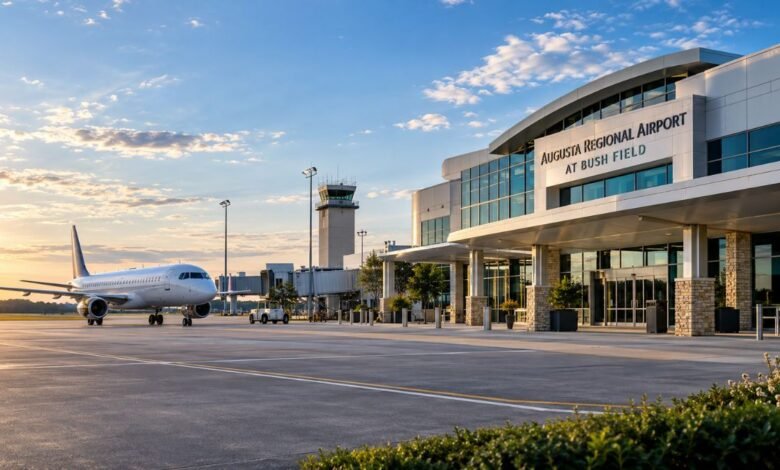
Augusta GA Bush Field is entering a consequential period. Augusta Regional Airport, known by the airport code AGS, is expanding parking capacity after rising air-travel demand put additional pressure on its ground facilities. In August 2026, airport officials temporarily closed Long-Term Parking Lot A for rehabilitation and the first stage of a broader parking expansion.
The numbers help explain the investment. Through November 2025, Augusta Regional Airport recorded 601,645 total arriving and departing passengers, up 7.61% from 559,085 during the comparable 2024 period. Passenger growth occurred even as total aircraft operations were slightly lower, suggesting more people were moving through AGS on available commercial capacity.
And Augusta has a travel pattern few regional airports experience. Each spring, the Masters Tournament produces an extraordinary surge of aviation activity. During Masters Week 2026, Delta and American supplemented Augusta’s regular routes with nonstop flights from major cities including New York, Boston, Los Angeles, Chicago, Miami, Phoenix, and others.
Bottom line: Augusta, GA, Bush Field is Augusta Regional Airport at Bush Field (AGS), the principal commercial airport serving the Central Savannah River Area. Delta and American Airlines provide regular passenger service, while two runways, general aviation facilities, military traffic, and expanding parking infrastructure make AGS a significant regional transportation hub.
Why the Name “Bush Field” Still Matters More Than 80 Years Later
Bush Field’s origins reach back to 1941, when the site was established as a military pilot-training facility during the rapid American aviation buildup surrounding World War II. Augusta government records describe the property as a former U.S. War Department facility associated with the Georgia Aero Flying School. The federal government later transferred the airfield to the City of Augusta, which developed it into a commercial airport.
The Bush Field name was adopted in memory of Don C. Bush, a civilian flight instructor who died in an aircraft accident in 1941, according to an Augusta Regional Airport environmental assessment. Commercial service began in 1950 after the property had passed into city control.
For decades, travelers simply knew the facility as Bush Field. That changed formally in 2000, when the airport was renamed Augusta Regional Airport at Bush Field to reflect its broader role serving Augusta and the surrounding Central Savannah River Area, or CSRA.
The old name never disappeared. “Bush Field” remains part of the airport’s official identity, while “AGS” is the code passengers encounter on tickets, baggage tags, and airline schedules.
Two Airlines Give Augusta Four Important Gateway Markets
The route network at AGS is compact, but its structure is useful because the nonstop destinations are major connecting points.
The airport states that Delta provides daily service to Atlanta, while
For passengers, this means AGS does not need dozens of nonstop destinations to provide broad connectivity. A traveler can leave Augusta, transfer at a major hub, and continue to destinations across the United States or internationally.
Schedules can change seasonally, however, so travelers should verify their specific dates directly with the airline before purchasing or traveling.
Beneath the Passenger Terminal Is a Serious Aviation Facility
Augusta Regional Airport is not merely a terminal building and several gates. FAA aviation data show a two-runway airfield designed to accommodate different categories of operations.
The FAA’s March 2026 airport diagram lists Runway 17/35 at 8,001 feet by 150 feet and Runway 8/26 at 6,001 feet by 100 feet. The same diagram identifies the passenger terminal, fixed-base operator, hangars, control tower, fire station, ramps, and interconnected taxiway system.
AGS also serves general aviation. Its airport-operated Fixed Base Operator operates 24 hours a day and provides services including Jet A and 100LL fuel, aircraft parking, ground power, courtesy transportation, flight-planning facilities, and pilot amenities. The airport also has an aircraft charging installation developed with BETA Technologies and Georgia Power.
Military traffic remains part of the airport’s identity. Augusta’s strong defense presence and nearby Fort Eisenhower generate military travel, and AGS maintains a dedicated Military Hospitality Suite inside the terminal for active and retired service members.
The 2026 Parking Project Shows Where AGS Is Headed Next
One of the most useful details for current passengers is also one of the most time-sensitive.
On August 26, 2026, Augusta Regional Airport announced the temporary closure of Long-Term Parking Lot A for approximately three months. The rehabilitation temporarily removes roughly 350 parking spaces from primary capacity.
The project is not simply maintenance. Airport officials said the completed work will create 50 additional spaces and form the first phase of improvements expected to add approximately 250 public parking spaces over two years. Long-Term Lots B and C, Short-Term Lot D and the credit-card lot remain available, with overflow parking designated when necessary.
For travelers using AGS in September 2026, arriving with extra time for parking is sensible. Airport officials are also encouraging drop-offs, rideshare services, taxis, and shuttles while construction continues.
Under the airport’s standard published rates, parking is free for the first 30 minutes. The listed daily maximum is $12 for short-term parking and $10 for long-term or credit-card parking. More than 900 long-term spaces are normally available, although construction temporarily affects capacity.
Masters Week Temporarily Changes What “Regional Airport” Means
No discussion of Augusta, GA, Bush Field is complete without the Masters Tournament.
For much of the year, AGS functions as a manageable regional airport centered on a limited scheduled network. Masters Week changes that equation dramatically.
For the April 6–13, 2026 Masters travel period, Delta announced additional direct service involving Austin, Detroit, New York-JFK, New York-LaGuardia, Boston, Los Angeles, Minneapolis-Saint Paul, Nashville, Newark, Raleigh-Durham and Washington National. American announced additional service involving Phoenix, Austin, Boston, New York-LaGuardia, Miami, Chicago and Philadelphia.
Those flights were event-specific additions, not evidence that every destination is part of AGS’s permanent year-round network. That distinction is important for travelers researching future flights.
The Masters operation nevertheless illustrates why Augusta’s airport infrastructure must support far more than ordinary daily passenger demand. For one internationally recognized sporting week, the airport becomes an intensive gateway for commercial travelers, private aircraft, charter operations, and ground-transportation providers.
What Passengers Actually Find Inside and Around AGS
The smaller scale of Augusta Regional Airport can work in a traveler’s favor. Rental cars, food, parking and passenger services are concentrated around a relatively compact terminal complex.
The airport lists Avis, Budget, Enterprise, Hertz, National, Payless, Thrifty and Dollar among its rental-car options.
Food options include Par 3 Bar & Grille beyond passenger screening and Wings Bistro in the main terminal near baggage claim. ATMs are available in both the main terminal and hold-room area, while AGS also provides free passenger Wi-Fi.
The airport is located on Doug Barnard Parkway/Highway 56 Spur, about four miles south of I-520’s Exit 10. Its official street address is 1501 Aviation Way, Augusta, GA 30906.
Passenger Growth Makes AGS an Economic Asset, Not Just a Convenience
Airport statistics show that AGS’s importance is growing.
Through November 2025, total passenger movements reached 601,645, compared with 559,085 for the same period in 2024. Total enplanements reached 302,910, up 6.78%, while total deplanements reached 298,735, up 8.47%.
The airport also reports a broader economic role beyond ticketed passengers. Its published economic-impact material attributes 1,561 jobs, more than $59 million in annual payroll, and approximately $269.6 million in economic output to airport activity. Those figures come from the airport’s economic-impact reporting and should be understood in the context of the methodology and study period used for that analysis.
That economic function connects aviation with Augusta’s manufacturing, defense, healthcare, tourism, and business sectors. AGS is therefore both transportation infrastructure and an economic-development asset for the wider CSRA.
Bush Field’s Next Chapter Is Already Taking Shape
Augusta Regional Airport has evolved repeatedly since its 1941 aviation-training origins: from military facility to municipal commercial airport, from Bush Field to Augusta Regional Airport at Bush Field, and now into a higher-demand regional gateway preparing its facilities for additional growth.
The clearest 2026 signal is not a new name or terminal opening. It is capacity investment. More passengers are using AGS, parking is expanding, infrastructure planning is continuing, and the Masters continues to show how strategically valuable the airfield becomes when Augusta’s travel demand peaks.
For travelers, the practical identity remains straightforward: Augusta GA Bush Field is AGS—the commercial airport serving Augusta and the wider CSRA, with direct access to major airline hubs and a far larger aviation role than its compact terminal might suggest.
FAQs.
Is Augusta GA Bush Field the same as Augusta Regional Airport?
Augusta GA Bush Field is Augusta Regional Airport at Bush Field. “Bush Field” is the historic name, while Augusta Regional Airport at Bush Field is the current official designation. The airport uses the IATA code AGS and serves commercial passengers as well as general, military, and other aviation activity.
What airlines fly from Bush Field in Augusta?
Delta Air Lines and American Airlines serve Bush Field commercially. Augusta Regional Airport currently lists Delta service to Atlanta and American service to Charlotte, Dallas, and Washington, D.C. Special-event flights, particularly during Masters Week, can temporarily add other nonstop destinations.
What is the airport code for Augusta Regional Airport at Bush Field?
The airport code for Augusta Regional Airport is AGS. FAA aviation documentation identifies the facility as Augusta Regional at Bush Field, while passengers will normally see AGS on booking systems, boarding documents, and baggage tags. Its principal runway is Runway 17/35.
How much does parking cost at Augusta Regional Airport?
Standard AGS parking starts with 30 minutes free. The airport currently publishes a $12 daily maximum for short-term parking and $10 daily maximums for long-term and credit-card parking. Because Long-Term Lot A entered temporary rehabilitation in August 2026, passengers should check current availability before departure.
Why is it called Bush Field?
Bush Field was named in memory of civilian flight instructor Don C. Bush, who was killed in an aircraft accident in 1941. The airfield originated as a military pilot-training facility and later became Augusta’s commercial airport. The facility retained the Bush Field designation when it was renamed Augusta Regional Airport at Bush Field in 2000.
Is Augusta Regional Airport only used for commercial flights?
Augusta Regional Airport is a mixed-use aviation facility. In addition to Delta and American passenger flights, AGS accommodates general aviation, air-taxi activity, military operations, and private aircraft. Its 24-hour FBO offers fueling, parking, flight-planning and pilot services, while the airfield includes two runways and an FAA control tower.
Editorial Disclaimer
Airport routes, airline schedules, parking availability, fees, construction arrangements, and passenger services can change without notice. Historical and operational facts in this article were checked against Augusta Regional Airport, City of Augusta, and FAA materials available at publication time. Travelers should confirm time-sensitive flight and airport information directly with AGS and their airline before travel.