Fontlu Explained: What the Emerging Typography Name Really Offers—and What Users Should Verify
Fontlu appears across design and typography searches, but separating its visible tools from the bigger claims around the name is essential.

Typography tools rarely become interesting because of the name printed above them. They become useful when they remove friction: testing a headline quickly, comparing typefaces, checking readability, understanding licensing, or getting usable CSS without wasting half an hour switching between tabs.
That is why Fontlu is attracting attention. Search results currently associate the term with font discovery, typography previews, font comparison, downloadable typefaces, and creative workflows. Yet an important complication remains: different websites use the Fontlu name in noticeably different ways. Some portray it as a sophisticated typography ecosystem, while other publicly visible implementations are much simpler.
For anyone searching “What is Fontlu?”, the useful question is therefore not merely what the name supposedly means. It is what can be verified, what Fontlu-style tools can actually accomplish, and what designers should check before relying on them professionally.
BLUF: Fontlu is best understood as an emerging name associated with browser-based typography and font-resource tools. Verifiable implementations include text previews and font-selection features, while another Fontlu-branded tool provides Google Fonts browsing, pairing, comparison, typography controls, and CSS export. Treat claims about a single universal Fontlu platform with caution.
The Fontlu Identity Is Less Straightforward Than Search Results Suggest
A search for Fontlu produces an unusually fragmented picture.
One current Fontlu website, Fontlu.net, describes itself as an online resource offering free and premium fonts for designers, developers, and content creators. Its public interface includes a “Font Creator Tool” where visitors can enter text, select a font and font size, preview the result, and copy text.
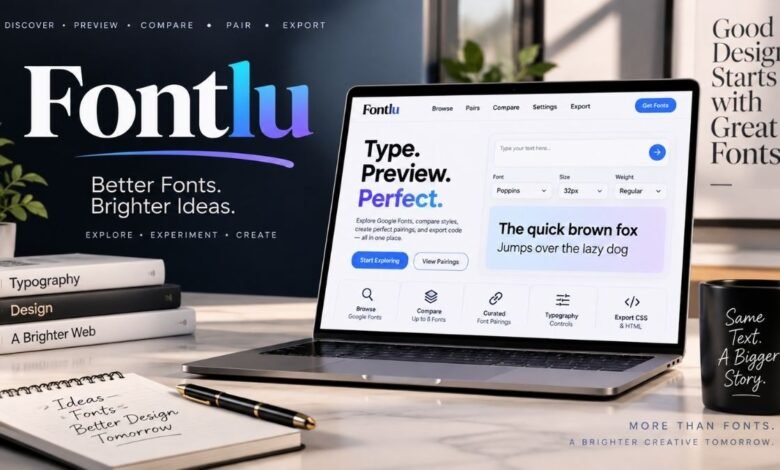
Separately, Langlation hosts a tool also called Fontlu. That implementation describes itself as a free browser-based typography utility featuring more than 45 Google Fonts. It provides font previews, browsing, curated pairings, side-by-side comparisons, typography controls, and code export.
Meanwhile, numerous articles describe Fontlu more broadly as a font-management ecosystem involving discovery, organization, collaboration, customization, cloud functionality, or intelligent font selection. The problem is that these descriptions are not always consistent with one another or with the functionality visible on current Fontlu-branded pages.
That distinction matters.
A recent examination of the term similarly concludes that Fontlu is not yet tied to one clearly established platform with a universally consistent definition.
What Can Be Verified Right Now?
Fontlu-related elementCurrent evidenceConfidence
Font-focused web resources Publicly visible High
Custom text preview Publicly visible High
Font-size adjustment Publicly visible High
Google Fonts implementation Visible on Langlation’s Fontlu tool High
Font comparison Visible on Langlation implementation High
Curated font pairings Visible on Langlation implementation High
CSS/HTML font code export Visible on Langlation implementation High
Large cloud font-management ecosystem Described by third parties Needs verification
Advanced AI capabilities Reported inconsistently Needs verification
Universal Fontlu account/platform Not clearly established Unverified
This is the safest way to describe Fontlu without turning promotional claims into facts.
Where Fontlu Becomes Useful: Seeing Typography Before Committing
The practical value of any Fontlu-style tool is straightforward: preview first, implement second.
Traditional font selection can be inefficient. A designer may discover a typeface, install or embed it, place it into a layout, adjust the sizing, and only then realize that it performs badly with the actual headline or paragraph.
Browser-based previews shorten that cycle.
The Langlation implementation of Fontlu lets users enter their own text and adjust font size, weight, italics, line height, letter spacing, word spacing, alignment, text transformation, decoration, text color, and background color. Changes appear in the preview while the user works.
That is more meaningful than simply scrolling through attractive alphabet specimens.
A font that looks excellent when displaying “Aa Bb Cc” may behave very differently when asked to render:
A Clearer Tomorrow
or:
Everything We Know About the Story Behind the Headlines
Real copy reveals practical characteristics such as width, visual density, spacing, readability, and hierarchy.
Font Comparison May Be More Valuable Than Font Discovery
Having thousands of fonts available does not automatically make typography easier.
Choice itself can become the problem.
The Fontlu implementation documented by Langlation approaches this with dedicated Browse, Pairs, and Compare functions. Its comparison feature can display as many as eight fonts using the same text, while its pairing area presents 12 heading-and-body combinations.
That makes comparison more controlled.
Instead of remembering how one font looked several browser tabs ago, a designer can judge alternatives against identical wording.
A Better Font Selection Test
When comparing fonts, appearance should not be the only criterion.
Check them against four practical questions:
- Readability: Can users understand the text comfortably at its intended size?
- Hierarchy: Is there a sufficiently clear distinction between headings and body copy?
- Character: Does the typeface support the brand rather than overwhelm it?
- Consistency: Will the font remain effective across desktop, mobile, graphics, and longer passages?
The “best-looking” font can lose once those questions are applied.
A highly decorative display face, for example, may work brilliantly for a three-word poster headline and terribly for a 700-word article.
Fontlu and Google Fonts Are Not Necessarily Competitors
Another point needs clarification.
Fontlu should not automatically be positioned as a direct replacement for Google Fonts.
At least one Fontlu implementation actually uses Google Fonts. Langlation says its Fontlu tool provides access to more than 45 Google Fonts and can generate either CSS or a Google Fonts HTML link for implementation.
That means the relationship can be complementary:
Google Fonts supplies the typefaces; a Fontlu-style interface helps users evaluate and configure them.
For developers, the export function is particularly practical. Once users select typography settings, the tool can generate implementation code rather than forcing them to recreate every property manually.
Fontlu-Style Workflow at a Glance
StagePractical action
Discover Browse suitable font categories
Preview Enter actual project copy
Configure Adjust weight, size, and spacing
Compare Evaluate alternatives using identical text
Pair Match heading and body fonts
Test Check readability at multiple sizes
Export Copy relevant CSS or font code
Verify Confirm licensing before publication
Never skip the final step.
Licensing Is the Part Designers Cannot Afford to Guess
Typography has both a creative side and a legal side.
Finding a font online doesn’t automatically mean you can use it commercially.
Fontlu.net states that many fonts may be free for personal use, while others require commercial licensing. It advises users to check individual licensing conditions before professional use.
That is particularly important for:
- company logos,
- client branding,
- commercial websites,
- advertisements,
- packaging,
- merchandise,
- applications,
- downloadable products.
A font preview is not a license.
Likewise, a download button does not necessarily establish unrestricted ownership rights.
For professional work, designers should trace the typeface back to its original foundry, creator, distributor, or authoritative licensing page whenever possible. The exact license—not a third-party summary—should determine whether the font can be embedded, modified, redistributed, or used commercially.
The Bigger Fontlu Claims Need More Evidence
This is where many Fontlu descriptions become problematic.
Some online articles portray Fontlu as an advanced platform offering cloud synchronization, collaboration, intelligent organization, extensive font management, AI assistance, or integrations with professional design software.
Those claims should not automatically be repeated as facts.
One independent examination of the publicly visible Fontlu.net website found a comparatively lightweight font resource and preview tool. Specifically, it warned that more elaborate third-party descriptions should not be assumed to represent its current capabilities.
This does not prove that advanced functionality cannot exist elsewhere under the Fontlu name.
It means only that the evidence currently available does not justify combining every online description into one definitive product specification.
That difference is critical for accurate reporting.
Fontlu is more useful when treated as an emerging typography term and collection of identifiable tools than when every online claim is bundled into one supposedly established software platform.
What Designers Can Actually Take From the Fontlu Idea
Even with ambiguity around the name, Fontlu’s workflow addresses a real design problem.
Typography selection is frequently fragmented.
Designers browse one resource for fonts, another for pairings, another for previews, and perhaps a fourth resource for implementation instructions. Tools that compress those decisions into one interface can save meaningful time.
The most useful Fontlu-related functions currently visible are therefore not futuristic ones.
They are basic, practical capabilities:
preview, compare, configure, pair, and export.
These features are especially useful for website owners who want to improve typography without becoming professional type designers.
A publisher, for example, might test a serif font for article headlines against a neutral sans-serif body font. An e-commerce designer could check whether a heavier font remains legible on mobile buttons. A developer could adjust line height and letter spacing before exporting CSS.
Small typography decisions can significantly change the reading experience.
Who Is Fontlu Most Relevant For?
Fontlu-related tools potentially serve several overlapping audiences.
Web designers can test headline and paragraph combinations before implementing them.
Developers can use browser-based configuration and code export to shorten experimentation.
Bloggers and publishers can compare fonts for readability across headlines, navigation elements, and article copy.
Brand designers can rapidly eliminate unsuitable typefaces before moving into deeper identity development.
Students and beginners can visually understand concepts such as font weight, line height, tracking, alignment, serif versus sans serif, and typographic hierarchy.
Professional type designers are a different audience.
Creating complete typefaces requires specialist capabilities involving glyph construction, kerning, OpenType features, variable-font engineering, language support, and extensive quality testing. Nothing currently verified about Fontlu establishes it as a replacement for dedicated professional font-development software.#
Why Fontlu Is Worth Watching—Without Believing Every Claim
Fontlu captures something real about contemporary design: people want typography tools to become easier, faster, and more visual.
A browser interface where users can enter real copy, compare typefaces, manipulate spacing, test pairings, and retrieve usable code makes sense. Those functions address everyday problems faced by designers, developers, publishers, and creators.
But Fontlu’s online identity remains fragmented.
Some pages demonstrate concrete functionality. Other websites attach much broader capabilities to the name. Until clearer documentation connects those claims to one authoritative product, treating every description as part of a single Fontlu ecosystem would create certainty the available evidence does not support.
That does not make Fontlu irrelevant.
It makes verification part of using it intelligently.
For users, the practical approach is simple: judge the specific Fontlu tool in front of you, test its functionality directly, verify font licenses at their authoritative source, and avoid assuming that features mentioned by third-party articles necessarily exist on every Fontlu-branded platform.
In typography, what appears on the screen matters.
With Fontlu, knowing exactly what sits behind the name matters, too.
FAQs,
What is Fontlu?
Fontlu is an emerging name associated with online typography, font discovery, and font-preview tools. Different websites currently use the name in different ways. Verified implementations range from a lightweight text-and-font preview resource to a browser typography tool offering Google Fonts, comparisons, pairings, detailed controls, and CSS export.
Is Fontlu a font itself?
Fontlu isn’t best understood as a single typeface. Current search evidence primarily associates the name with typography resources, font-selection tools, and design-related websites. Because several different sources use the term, users should check which particular Fontlu service or page a search result refers to.
Is Fontlu free?
Some Fontlu-branded functionality is available for free. Langlation describes its Fontlu typography utility as free, browser-based, and login-free. Fontlu.net also describes a mix of free and premium font resources, so availability and licensing can differ depending on the typeface or Fontlu implementation.
Can Fontlu help choose font combinations?
Yes, at least one Fontlu implementation provides dedicated font-pairing functionality. Langlation’s Fontlu tool currently advertises 12 curated heading-and-body combinations, along with font browsing and comparison features. Designers should still test combinations against their own content, branding, screen sizes, and accessibility requirements.
Can Fontlu fonts be used commercially?
Commercial use depends on the license attached to the individual typeface, not merely on where it was discovered. Fontlu.net acknowledges that some fonts may require commercial licenses. Designers should verify the original license before using any downloaded font for logos, advertising, client projects, products, or other commercial applications.
Does Fontlu replace professional typography software?
There is currently insufficient evidence to describe Fontlu as a replacement for professional font-development software. Its clearly verifiable strengths center on font previewing, selection, comparison, pairing, and typography configuration rather than the complete engineering workflow required to create sophisticated commercial typefaces from scratch.
Editorial Disclaimer
Information about Fontlu is based on publicly accessible material available at the time of verification. The name is used across multiple websites and third-party articles with inconsistent descriptions. Features, ownership details, pricing, licensing terms, and availability can change. Users should verify the specific Fontlu service and original font license before relying on either for commercial work.