Tomazen Explained: What the Viral Wellness Term Actually Means—and What the Evidence Really Says
Tomazen is appearing across wellness content, but the most important fact is the one many explanations miss: the name does not yet point to a single standardized product or a scientifically established formulation.

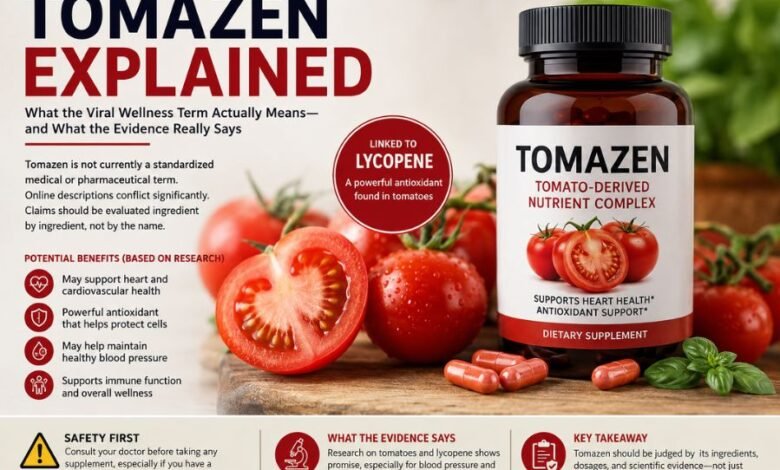
Tomazen has begun to surface in health and lifestyle searches, with surprisingly confident claims attached to it. Some pages describe it as a tomato-derived supplement, while others present Tomazen as a broader wellness blend involving adaptogens, vitamins, antioxidants, or focus-supporting ingredients. Still other online references use the term in completely different contexts.
That inconsistency matters. Consumers searching for Tomazen may assume they are researching a recognized compound with a fixed ingredient profile and established clinical evidence. At present, authoritative medical and regulatory evidence does not support treating the word that way.
Instead, the useful question is not simply, “Does Tomazen work?” It is: What exactly is being sold or described under the Tomazen name, what ingredients does it contain, and is there credible human evidence for those ingredients?
The First Tomazen Problem Is Definition, Not Effectiveness
A legitimate scientific evaluation normally begins with a clearly identifiable intervention: a drug molecule, botanical extract, vitamin, food, dosage, or standardized mixture.
Tomazen does not currently provide that clarity.
One published online explanation defines Tomazen as a concept involving concentrated nutrients obtained from tomatoes, particularly compounds associated with Solanum lycopersicum. Another describes Tomazen as a wellness formulation that may contain adaptogens such as ashwagandha or rhodiola, nutrients such as B vitamins or L-theanine, antioxidants, magnesium, or zinc.
These are materially different formulations.
A tomato extract rich in lycopene cannot be scientifically treated as equivalent to an adaptogenic herbal blend. Dosages, mechanisms, interactions, clinical outcomes, contraindications, and manufacturing standards would all differ.
This distinction is essential for both consumers and publishers. Repeating benefits from tomato studies under the Tomazen label without verifying that a Tomazen product contains equivalent standardized ingredients would create a scientific leap the evidence does not justify.
Why Tomatoes and Lycopene Keep Appearing in the Conversation
The tomato-based interpretation of Tomazen is understandable because tomatoes contain lycopene, a carotenoid extensively studied for its antioxidant properties and potential cardiovascular effects.
Research here is real—but considerably more nuanced than many wellness headlines suggest.
A 2017 systematic review and meta-analysis of 21 eligible intervention studies found associations between tomato interventions and improvements in several cardiovascular markers, while lycopene supplementation was associated with reductions in systolic blood pressure.
However, later reviews have not produced uniformly positive results.
A systematic review of 34 studies reported that tomato or lycopene consumption did not significantly improve most assessed cardiovascular risk markers. However, lycopene supplementation was associated with improvement in a marker of oxidative stress. The authors called for further long-term studies.
Another large review of 43 studies likewise found substantial variation in the doses and forms of lycopene used and reported conflicting cardiovascular findings.
That is a much more accurate picture than describing lycopene as a guaranteed cardiovascular supplement.
Newer Evidence Gives Lycopene a Stronger—but Still Specific—Signal
More recent research adds another layer.
A 2026 umbrella review examined systematic reviews and meta-analyses of intervention studies involving tomatoes or naturally occurring lycopene. Nine systematic reviews were included, seven of which contained meta-analyses. The authors reported the strongest evidence around improvements in blood pressure, while findings involving lipid profiles were less consistent.
A separate network meta-analysis of 11 studies found that standardized tomato extract reduced systolic blood pressure compared with placebo, with stronger effects reported among participants with hypertension. Other tomato and lycopene preparations did not consistently produce the same result.
That last point deserves attention: even scientifically related products are not necessarily interchangeable.
The evidence supports studying specific tomato preparations and specific lycopene interventions. It does not support transferring every reported effect to anything carrying the Tomazen label.
Editorial assessment: The scientifically responsible position is to separate evidence about tomatoes, lycopene, and standardized tomato extracts from claims about Tomazen until a precise Tomazen formulation can be independently identified.
Whole Tomatoes May Be More Relevant Than the Supplement Hype Suggests
Supplement marketing often isolates one compound and presents concentration as an automatic advantage. Nutrition science does not always work that way.
A review comparing tomatoes with lycopene supplements found that tomato-based foods generally produced more favorable cardiovascular results than isolated lycopene supplementation across several outcomes. However, supplemental lycopene showed promise in blood-pressure research.
A randomized controlled trial involving 225 adults aged 40 to 65 compared a low-tomato control diet, a high-tomato diet, and daily lycopene supplementation. The intervention did not significantly change several systemic cardiovascular markers that researchers evaluated.
An umbrella review covering multiple health outcomes also found potentially beneficial associations involving tomato and lycopene consumption. Still, it stressed that the quality of evidence was low or very low for most outcomes.
What the Evidence Actually Allows Us to Say
- Tomatoes are a legitimate nutrient-rich food.
- Lycopene is a well-studied carotenoid.
- Some clinical evidence suggests effects on blood pressure and certain cardiovascular markers.
- Findings vary according to the population, preparation, dose, and study design.
- Observational associations do not automatically prove that supplementation prevents disease.
- Tomato and lycopene research cannot establish the effectiveness of an undefined product called Tomazen.
That final distinction is the key to interpreting the keyword responsibly.
Buying Something Called Tomazen Requires a Label-First Approach
If Tomazen appears on an actual dietary supplement, consumers should evaluate the Supplement Facts panel rather than the marketing name.
The U.S. National Institutes of Health Office of Dietary Supplements advises consumers to check the listed ingredients and amounts per serving. NIH also notes that supplements cannot replace the variety of foods required for a healthy diet and that many supplements still need additional research to determine their effectiveness.
The FDA makes another important distinction: dietary supplements are not approved for safety and effectiveness before reaching the market in the same way new pharmaceutical drugs are. Manufacturers are responsible for ensuring safety and truthful labeling.
Before evaluating a Tomazen-labeled product, check:
- Complete ingredient list
- Exact dose of each active ingredient
- Manufacturer identity and contact information
- Batch or quality-testing information
- Allergen declarations
- Warnings and medication interactions
- Whether health claims match evidence for the actual dosage used
A product making disease-treatment or “instant cure” claims deserves particular scrutiny. FDA guidance explicitly distinguishes dietary supplements from products intended to diagnose, treat, cure, or prevent disease.
Why “Natural” Still Does Not Answer the Safety Question
Natural origin is not equivalent to universal safety.
Supplement ingredients can interact with prescription medicines, other supplements, or existing medical treatment. FDA and NIH both recommend discussing supplement use with a doctor, pharmacist, or other qualified healthcare professional, particularly when medications or health conditions are involved.
The question becomes particularly important if a Tomazen formula includes multiple botanicals, minerals, or concentrated extracts, because the risk depends on what is actually inside the product.
A bottle name cannot reveal that.
FAQs
What is Tomazen?
Tomazen is currently an inconsistently defined term rather than a clearly standardized medical compound. Some online articles associate it with tomato-derived nutrients, while others describe very different wellness formulations. Consumers should identify the exact product and ingredient list before interpreting any claimed benefits.
Is Tomazen the same as lycopene?
Tomazen is not established as another scientific name for lycopene. Lycopene is a defined carotenoid naturally abundant in tomatoes and has an established research literature. A Tomazen product should not be assumed to contain lycopene unless its verified ingredient label specifically says so.
Does Tomazen lower blood pressure?
There is insufficient evidence to say that Tomazen itself lowers blood pressure. Research has found potential effects on blood pressure from certain standardized tomato extracts and lycopene interventions. Still, those findings apply to the preparations studied rather than to every product associated with the Tomazen name.
Is Tomazen FDA approved?
Dietary supplements themselves are not FDA-approved for safety and effectiveness before marketing. Therefore, describing a dietary supplement as “FDA approved” can be misleading. FDA instead regulates supplement manufacturing, labeling, and marketplace safety under a different framework from pharmaceutical drugs.
Is Tomazen safe to take every day?
Tomazen cannot be given a universal daily-safety verdict without knowing its exact ingredients and dosages. A tomato-derived formulation, herbal mixture, and multi-nutrient supplement have different safety profiles. Consumers taking medicines or managing health conditions should review the precise formulation with a qualified healthcare professional.
The Name Is Less Important Than the Evidence Behind the Bottle
Tomazen illustrates a growing problem in online wellness information: a searchable name can become popular faster than a stable scientific definition emerges.
There is credible research surrounding tomatoes, lycopene, and standardized tomato extracts. Some findings—particularly around blood pressure—are promising. Other findings remain inconsistent, and the quality of evidence differs significantly across outcomes.
That evidence should be represented accurately rather than stretched.
Until Tomazen can be tied to a specific, standardized formulation supported by reproducible human research, the strongest evidence-based answer is straightforward: judge Tomazen by its verified ingredients, doses, and clinical evidence—not by the popularity of the name.
Editorial Disclaimer
This article is informational and does not diagnose, treat, or recommend treatment for any medical condition. Public descriptions of Tomazen are inconsistent, so no universal ingredient list, dosage, clinical benefit, or safety profile should be assumed from the name alone. Health claims should be checked against the exact formulation and reliable clinical evidence.