TR-EX.ME: What Happened to the Context Translation Site, and What Should Users Use Now?
The contextual translation tool built around real-world sentence examples developed a loyal following—but in 2026, accessing TR-EX.ME has become a very different story.

For language learners, translators, writers, and people trying to understand an unfamiliar phrase, a literal translation is often not enough. The real question is how a phrase is actually used—and how native speakers express the same idea in another language.
That was the attraction of TR-EX.ME. Rather than behaving only like a conventional word-for-word translator, the service presented translations alongside sentence-level examples, giving users a way to compare meanings across contexts.
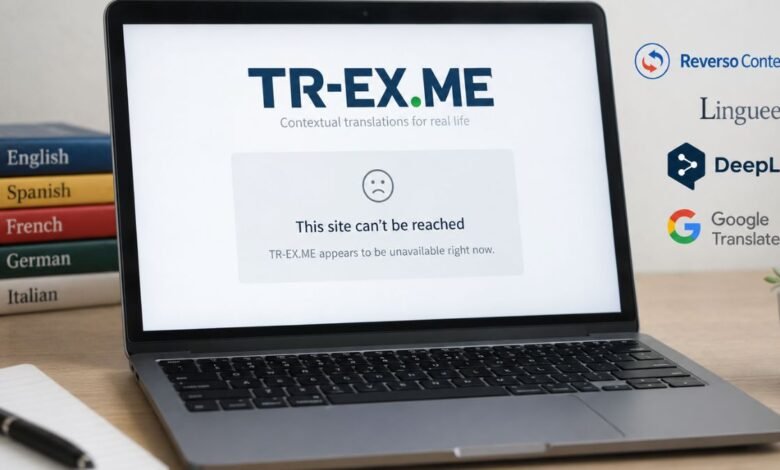
But there is an important development anyone searching for TR-EX.ME in 2026 should know: the website has experienced prolonged accessibility problems. Multiple independent monitoring services have reported it unavailable for months, and a direct attempt to access the domain also failed. That does not, however, prove that the project has permanently closed.
BLUF: TR-EX.ME is a contextual bilingual translation and dictionary service known for showing translated phrases in real sentence examples. As of September 2026, the website appears broadly inaccessible, although its domain remains registered until February 19, 2027. No authoritative public announcement confirmed a permanent shutdown.
Why TR-EX.Was Different From a Basic Translator
The basic idea behind TR-EX.ME was straightforward: translation becomes much more useful when readers can see a word or phrase inside complete sentences.
Archived descriptions of the platform characterize TR-EX. as a bilingual contextual dictionary containing different translations of phrases, along with examples showing how those translations were used. Its database drew on previously translated material including dialogue, documents, and multilingual websites.
That matters because a single expression can have dramatically different translations depending on tone, grammar, speaker intent, region, or surrounding vocabulary.
Consider an English expression such as:
A Large Search Footprint Existed Before the 2026 Access Problems
TR-EX.ME was not simply an obscure translation page with a handful of indexed terms.
Historical Ahrefs data reported approximately 176,000 estimated monthly organic search visits and about 266,000 ranking keywords in July 2025. Indonesia represented the largest share of estimated search traffic at the time, followed by India, Malaysia, Vietnam, and the Philippines.
Treat those figures as third-party SEO estimates rather than TR-EX. ME’s internal analytics. Still, they show why the service’s disappearance or prolonged unavailability has been noticeable.
Many of its search queries were long-tail requests involving meanings and translations of entire expressions rather than isolated dictionary words.
This is where contextual translation databases can perform well: users often search for something too specific for a traditional dictionary entry.
What Happened to TR-EX.in 2026?
This is where separating evidence from speculation becomes important.
A language-learning community discussion published in April 2026 reported that TR-EX.ME had begun returning a 403 Forbidden response. The user described the service as unavailable and asked for comparable alternatives. That discussion is useful evidence of user experience, but it is not an official shutdown statement.
More recent monitoring strengthens the case that the accessibility problem has persisted.
One website-status service recorded repeated failed checks during June and July 2026, with approximately 10-second timeouts. Another status provider reported TR-EX.ME as inaccessible for roughly four months and showed zero uptime during its measured 30-day period.
A September 2026 monitoring snapshot also listed the domain as offline.
At the same time, some automated status services have produced conflicting results, occasionally labeling the site online. Such disagreement can occur because monitoring nodes use different geographic locations, DNS resolvers, caching systems, request methods, or server responses.
The responsible interpretation is therefore:
TR-EX.ME has strong evidence of prolonged accessibility problems in 2026, but there is insufficient public evidence to state definitively that its owners permanently discontinued the service.
No Verified Shutdown Announcement Has Surfaced
A registered domain can remain inaccessible for many reasons: server failure, DNS configuration, hosting changes, access restrictions, maintenance, financial issues, security changes, or an abandoned project.
No verified public statement from TR-EX. ME’s operator explaining the outage.
That distinction matters.
“TR-EX.ME is currently inaccessible” is supported by evidence.
“TR-EX.ME permanently shut down because of a specific reason” would require evidence that is not presently available.
Why Contextual Translation Still Matters Even With Modern AI
Modern translation systems have become substantially more capable, but contextual examples remain useful for a different reason.
A machine translation tool tries to generate what it believes is the best translation.
A contextual corpus lets the user inspect several examples and make a judgment.
That difference is especially valuable with idioms, slang, phrasal verbs, technical vocabulary, conversational language, and words with several meanings.
For example, translating the English word “charge” depends heavily on context.
It may relate to:
- a payment;
- an electrical charge;
- responsibility for something;
- accusing someone of an offense;
- moving toward someone aggressively;
- charging a battery.
Seeing the surrounding sentence removes ambiguity that a standalone dictionary entry cannot.
TR-EX. ME’s former appeal was therefore less about replacing every Translator and more about giving users evidence they could compare.
The Strongest TR-EX. MEME Alternatives Available Now
Users looking for a direct replacement will probably need to combine tools because the major translation platforms emphasize different strengths.
Service Best suited forContext examplesBroader translation features
Reverso Context Idioms, expressions and sentence examples Strong Strong
Linguee Parallel texts and dictionary research Strong Moderate
DeepL Fluent text and document translation Limited compared with dedicated context search Very strong
Google Translate Fast multilingual translation and broad language coverage Limited compared with corpus tools Very strong
Reverso Context Is the Closest Match for Sentence-Based Searching
For someone specifically missing TR-EX. ME’s contextual results, Reverso Context is one of the closest mainstream alternatives.
Reverso says its system searches examples extracted from millions of previously translated texts, including movie dialogue, official documents, websites, and newspapers. Users can select a proposed translation and filter results to examples containing that translation.
Its current service also emphasizes idioms, slang, expressions, pronunciation, definitions, vocabulary lists, and learning exercises. Reverso reports support for more than 100 language pairs.
For phrase research, that structure is much closer to the traditional TR-EX.ME experience than a simple translation box.
Linguee Remains Valuable for Parallel Text
Linguee is another useful option when the objective is to compare translated sentences from documents.
Its search results combine dictionary entries with example sentences and alternative translations. Some results clearly identify external source material, which helps users see how terminology appears in longer-form text.
Linguee is particularly useful for professional, institutional, legal, technical, and formal language, although the usefulness of individual examples naturally depends on the available source corpus.
DeepL Is Better When You Need the Translation Itself
DeepL serves a somewhat different purpose.
Its Translator supports text and file translation, with document workflows that preserve the structure and formatting of supported documents. DeepL also offers features such as glossaries, translation alternatives, formality controls, and document translation.
DeepL is therefore a stronger choice when the primary need is producing a polished translation rather than searching through many previously translated sentence examples.
Google Translate Wins on Language Reach
Google Translate remains one of the broadest general-purpose options.
Google says its Translate app works with text, handwriting, photos, and speech in more than 200 languages, with website translation also available.
That makes it highly practical for everyday translation, although its workflow is different from a dedicated bilingual corpus designed around browsing multiple contextual examples.
A Better Way to Replace TR-EX.ME Rather Than Relying on One Tool
The best replacement strategy isn’t necessarily finding a website that looks identical.
It is using different tools for different stages.
For an unfamiliar phrase, start with Reverso Context or Linguee to examine real usage. Then use DeepL or Google Translate to test complete sentences. Finally, compare several examples before using the wording in important academic, legal, medical, financial, or professional material.
This reduces one of the biggest risks of online translation: accepting the first answer without checking whether the context actually matches.
Automated translation systems are enormously useful, but none should be treated as infallible.
Why TR-EX.Still Matters Even While It Is Offline
TR-EX.ME highlighted something that remains important in the AI translation era: meaning rarely lives in a single word.
Context tells us whether language is serious or sarcastic, literal or idiomatic, formal or casual, technical or conversational.
That is why users can miss a context-search tool even while having access to sophisticated machine translation.
As of September 2026, the evidence indicates that TR-EX.is suffering prolonged availability problems. We cannot say that the service has disappeared forever.
Until its status becomes clearer, users who depended on it can reproduce much of its old workflow through Reverso Context for examples, Linguee for parallel texts, and DeepL or Google Translate for full translations.
The tools have changed. The underlying translation principle has not: never judge an expression without looking at the surrounding sentence.
FAQs
What is TR-EX.ME?
TR-EX.ME is a contextual bilingual translation website known for showing possible translations of words and phrases alongside example sentences. Its approach helped users understand how vocabulary and expressions could change meaning depending on context rather than relying only on direct word-for-word definitions.
Is TR-EX.down in 2026?
TR-EX.ME appears to be broadly inaccessible as of September 2026. Multiple independent monitoring services have reported lengthy periods of downtime, and a direct retrieval attempt also failed. However, monitoring results are not completely uniform, so the evidence supports prolonged unavailability rather than a definitive claim of permanent closure.
Has TR-EX.ME permanently shut down?
No public evidence confirms a permanent TR-EX shutdown. Community reports began discussing serious access problems in early 2026, but no authoritative shutdown announcement was identified. The domain also remains registered through February 19, 2027. Domain registration does not guarantee a return, but it means you should not assert permanent closure without further evidence.
What is the best TR-EX.ME alternative?
Reverso Context is probably the closest major alternative for contextual sentence translation. It searches a large corpus of previously translated material and provides multiple examples for words, expressions, and idioms. Linguee is another strong option for parallel-text research, while DeepL is better suited to generating complete translations.
Is TR-EX.ME a normal machine translator?
TR-EX.ME was more accurately described as a contextual translation dictionary than a basic machine translator. Its distinctive value came from presenting translated phrases with example sentences, allowing users to see how a translation worked in different contexts. Some translations were algorithmically generated and could contain errors.
Can contextual translation examples be wrong?
Contextual translation examples can be inaccurate or poorly aligned. Translation corpora may contain errors in the source, imperfect sentence pairing, literal translations, or examples that do not match the reader’s intended meaning. Reverso itself warns that alignment and translation errors can occur in contextual datasets, showing why you should check multiple examples.
Editorial Disclaimer
Website availability can change without notice. Status information in this article reflects checks and publicly available evidence reviewed in September 2026. Third-party traffic estimates, uptime monitors, community reports, and archived descriptions are not equivalent to statements from TR-EX. ME’s operator. No unsupported explanation for the site’s prolonged unavailability has been presented as fact.