Zecway: A Powerful AI Platform Transforming Workplace Search and Business Productivity

Finding information at work should be easy, but for many businesses, it’s more complicated than expected. Key documents end up in different folders, project discussions get lost in chat apps, and important decisions are buried in email threads. Employees often waste time looking for information that already exists somewhere in the company. Zecway is a new AI platform that solves this problem by bringing company knowledge together in one place.
Instead of being just another search tool, Zecway takes a broader approach to managing workplace knowledge. It combines smart information search, AI-powered help, and automated workflows so employees can spend less time searching and more time on important work. As AI becomes more common at work, this approach meets the need for technology that can understand and organize business information.
This article covers what Zecway is, how its technology works, its main features, potential benefits and drawbacks, and what businesses should consider before using it.
What Is Zecway?
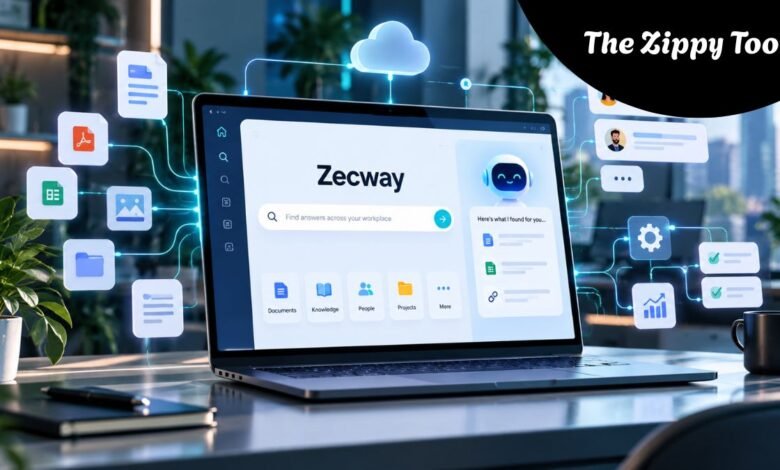
Zecway is an AI-powered platform that helps employees find, understand, and use company information more easily. Its main goal is to connect information from different business apps and give employees one place to ask questions and get useful answers.
Most businesses use several digital tools to run their daily operations. For example, Google Drive might store key documents, Slack might have important conversations, and other apps might keep project notes or customer details. While each tool is useful, it becomes hard to manage information when employees have to search each one separately.
Zecway aims to solve this by offering a single, AI-powered search experience. Employees don’t need to know exactly where a document is—they can ask questions in plain language and get answers backed by company records.
As of October 2026, Zecway is offering early access. This means the publicly described features may not all be proven or available for everyday business use yet.
The Idea Behind Zecway
The central idea behind the platform is that companies already possess much of the information employees need, but that knowledge is oThe main idea behind Zecway is that companies already have most of the information employees need, but it’s often hard to find. Traditional workplace systems focus on storing certain types of content instead of connecting information across the whole company. A team conversation may have discussed an important pricing decision. Additional details could be stored in email correspondence. Gathering everything requires switching between applications and comparing different records.
A smart workplace search system could make this easier by pulling related information from different sources and showing it all in one place. This could boost productivity, especially in companies with many documents, frequent communication, and multiple departments.
The aim isn’t to replace existing workplace apps, but to make the information inside them easier to find and use.
How Does Zecway Work?
Zecway describes its system as having three parts: unified search, an AI assistant, and automated agents. Each part offers a different way for employees to use company information, moving from finding knowledge to putting it to work.
Unified Search Across Business Applications
The first part is about finding information. Instead of searching each app one by one, employees use a single interface to find documents, conversations, and other records. They can search in everyday language, even if they don’t remember the exact file name or terms.
For example, an employee could ask where the latest marketing presentation is. The system might find the file and show related discussions about recent updates, providing more context than just a list of files.
Zecway advertises quick search results; for example, one response took about 0.4 seconds. However, these numbers are promotional and may not reflect real performance in every company or setup.
AI Assistant for Workplace Knowledge
The second part is an AI assistant that helps with tasks needing a deeper understanding of information. Instead of just showing documents, it tries to give helpful answers based on company sources.
An employee preparing a proposal might ask the assistant to summarize company policies or draft a reply. For example, someone working on a proposal could ask the assistant to summarize company policies or draft a reply using product documents. The system can gather the right information and prepare a first draft for review. records used to support an answer, the platform aims to make generated information more transparent. Employees can then check whether the underlying material is accurate, complete, and current.
Still, source references don’t guarantee every answer is right. People need to use their own judgment, especially for important decisions.
AI Agents and Workflow Automation
The third layer involves AI agents, which handle more complex or repetitive business tasks. These agents go beyond just giving information—they can help prepare work and support actions. This could include a summary of project developments, customer feedback, or internal operational changes. An AI agent could potentially gather relevant information, organize the findings, and prepare an update.
The company’s examples also emphasize human approval; certZecway notes that some actions require human approval. This matters because companies need to control what automated systems can do on their own and what requires permission. nal during early access rather than assuming every promotional example is already available.
Main Features of Zecway
Zecway offers several features that may interest businesses exploring artificial intelligence.
Centralized Knowledge Discovery
One standout feature is Zecway’s goal to bring information from different workplace apps into one searchable place. This centralized search is especially helpful for growing companies where employees rely on records from many departments.
When information is easier to find, teams don’t have to keep asking coworkers for documents or explanations. This improves collaboration and reduces interruptions.
Source-Referenced Answers
Another key feature is linking answers to their sources. This matters most when information affects business decisions, client communication, or company policies.
Employees should be able to check the evidence behind AI answers instead of just trusting them. In practice, this feature is only helpful if the sources are accurate, easy to access, and detailed enough.
Permission-Aware Access
Zecway says it uses a permission-aware system that respects current access rules. Employees should only see information they’re allowed to access.
For example, someone in HR might be able to see confidential records that other departments can’t. A good permission system should maintain these limits when using AI to find information.
The company states that it enforces access controls before information reaches its AI systems. This is a significant security claim, but businesses should request technical evidence and test it themselves before connecting confidential company data.
Why Workplace Knowledge Management Matters
Managing knowledge is now central to running a business. Companies create lots of information in documents, chats, reports, and projects. Without good organization, important knowledge can be hard to find or only available to a few people.
This problem becomes especially apparent when employees change jobs or leave. Important details might be in old conversations, but new team members may not know where to look. Poor access to information can slow onboarding, lead to repeated questions, and increase the likelihood that people use outdated information.
AI-powered knowledge management can help by making it easier to find information through simple questions. But technology alone can’t fix missing records, messy documentation, or bad information practices. Companies still need to keep their information reliable for smart search tools to work well.
Potential Benefits for Businesses
Zecway’s main benefit is improved efficiency. When employees can quickly find the right information, they spend less time searching through folders, messages, and apps. This frees up time for customer service, planning, problem-solving, and other important work.
Another benefit is improved cross-departmental teamwork. When permissions allow, information from sales, marketing, operations, and management is easier to find. This helps everyone understand the business better and avoids repeating work.
Zecway can also help with more consistent knowledge sharing. If employees can find policies, past decisions, and approved documents, they’re more likely to follow the right procedures.
These are possible benefits, not guaranteed results. Their real value depends on how well Zecway is set up, how accurate the search is, whether employees use it, and how good the company’s information systems are.
Who Could Benefit From Zecway?
The platform’s public positioning focuses particularly on teams of approximately 30 to 500 employees. Organizations in this range may have accumulated enough information to face knowledge-management challenges without the resources to build customized enterprise search infrastructure.
Tech companies, service firms, marketing agencies, and other organizations that handle lots of information might find Zecway useful. Teams that often use many apps or rely on detailed internal documents have even more reason to try unified search.
Smaller companies could also benefit too if their information is spread across different systems. But their needs might be simpler, and whether extra software is worth it depends on price, setup, and clear benefits. Need more extensive administrative controls, compliance capabilities, and integration support before considering adoption.
Zecway and Traditional Workplace Search
Traditional workplace search helps people find files, messages, or records in a single app. Employees usually type keywords and sift through results to find what they need.
An AI-powered knowledge system goes further by understanding questions in plain language, pulling information from several connected apps, and preparing answers based on what it finds.
The difference isn’t just about speed. It’s about connecting context across different records and turning what it finds into something useful.
Still, traditional search is useful because it lets users go straight to the original material without AI in the middle. The best modern systems should make it easy to find things and give clear access to source documents.
Is Zecway Safe for Business Information?
Security is a major concern when a company connects internal information to external software. Business documents can include financial data, private customer records, contracts, or employee details that need strong protection.
Zecway highlights its permission-aware search, but companies should look beyond marketing claims when checking security. They should consider data encryption, access controls, data retention, audit logs, vendor roles, and incident response.
Companies should also determine where their data is processed, how integrations are secured, whether customer data trains AI models, and how they can remove access if needed.
It’s often smart to start with a small test using non-sensitive data. Before granting broader access, admins should confirm users can only see what their permissions allow.
Pricing and Availability
As of October 2026, the company’s public website proAs of October 2026, Zecway’s website offers limited early access and doesn’t list standard subscription prices yet. Users are asked to provide a work email address, and the request says no credit card is required. This should not be confused with a guarantee of permanently free software or unrestricted access.
Businesses considering the proCompanies interested in Zecway should check prices, supported integrations, user limits, onboarding, and tech support directly with the provider. Publish which features are included in the current release and which remain part of the company’s future development plans.
Challenges and Limitations
Although Zecway has a promising idea, it faces challenges common to other new AI workplace tools. One issue is the quality of company records. Even the best search systems can struggle if documents are outdated, inconsistent, incomplete, or disorganized.
Another challenge is the AI’s reliability. Its answers can be wrong, miss key details, or mix up information from different sources. Citations help with checking, but they don’t remove these risks.
Integration can also be tricky. Connecting several apps needs the right permissions, regular maintenance, and reliable syncing. Companies should know how the system handles changes or app outages.
Finally, independent information about real-world performance, long-term reliability, and broad commercial deployment remains limited. These uncertainties make practical evaluation especially important.
Understanding the Company Behind the Name
Public records link the Zecway name to Zecway Studio LLP, a company registered in Bengaluru, India, in June 2024. Older online info connects the name to creative and marketing services.
Meanwhile, the current product webCurrently, Zecway’s website shows it as an AI workplace knowledge platform, and its company profile lists software development as its main activity. These should be combined into a single verified corporate history. Businesses evaluating a commercial agreement should establish the legal entity responsible for the service and confirm its contractual and data-processing responsibilities.
The Future of Zecway
Workplace software is moving toward tools that combine information search, AI, and automation. Companies want to cut down on repetitive tasks while keeping easy access to their knowledge.
Zecway’s vision fits this developing market by making search the foundation, adding AI support, and offering automated agents as an added layer. Capabilities work with real organizational data. Trustworthy answers, dependable permissions, practical integrations, and measurable productivity improvements will matter more than impressive demos alone.
If the platform can deliver consistent results while maintaining appropriate safeguards, it may become a useful option for companies seeking a more connected workplace experience. For now, its development and adoption remain worth watching.
Conclusion
Zecway is a new way to tackle a common business problem: finding and using information that’s already in the company. By bringing together unified search, AI-backed answers, and workflow automation, it aims to help teams work more efficiently and get more from their knowledge.
By focusing on permission-aware search and clear information sources, Zecway addresses common business concerns about AI. Still, because it’s in early access and there’s little independent proof of its performance, companies should review its features carefully.
What matters most isn’t how fast the AI answers, but whether the answer is accurate, allowed, useful, and reliable for daily work.
(FAQs)
1. What is Zecway used for?
Zecway is an AI-powered workplace knowledge platform that helps employees search for information across connected business applications. Its broader vision includes AI-generated answers, document assistance, and workflow automation.
2. Is Zecway available for free?
The platform currently promotes early-access registration without requiring a credit card. However, Zecway has not publicly set long-term subscription prices or permanent free-plan arrangements.
3. How is Zecway different from traditional search tools?
Traditional search tools generally locate files or messages, often within individual applications. Zecway aims to search across connected workplace systems, interpret natural-language questions, and provide answers supported by sources.
4. Can Zecway protect confidential company information?
The company describes permission-aware search designed to prevent unauthorized access. Businesses should independently assess these controls and review security documentation before connecting sensitive data.
5. Is Zecway suitable for small businesses?
It may suit smaller businesses that manage information across multiple applications, although its publicly stated target is teams of about 30–500 employees. Suitability depends on actual features, costs, security requirements, and the organization’s needs.