Tableau Chef Explained: The Data-Visualization Skill Set Behind Clearer, Smarter Tableau Work
"Tableau chef" might sound like a job title, but it actually refers to someone who turns messy data into clear, useful analysis.

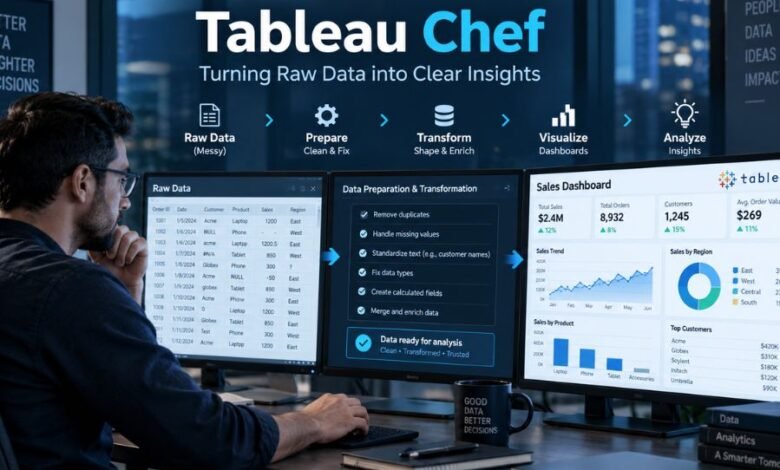
Searching for “tableau chef” can be confusing since it is not an official Tableau job title or certification. Online, it is mostly used as a metaphor for someone who takes raw data, prepares it thoughtfully, chooses the right analysis, and presents the results through dashboards and visual stories.
This difference is even more important in 2026, as Tableau continues to evolve. Tableau now focuses on agentic and conversational analytics, and Tableau Prep is combining visual data preparation with AI-powered transformation. The latest version, Tableau Prep Builder 2026.2.2, was released on August 27, 2026.
Being skilled with Tableau now means more than just knowing how to build charts. The real value is in managing the whole process, from messy source data to reliable business answers.
In short, “Tableau chef” is not an official job title. It is an informal way to describe someone who prepares data, creates clear visualizations, and communicates insights well. The closest real job titles are Tableau Data Analyst, Tableau Consultant, BI Analyst, and Analytics Developer.
What “Tableau Chef” Really Means—and What It Doesn’t
Tableau does not currently list Tableau Chef as a formal certification title. Its certification catalog instead includes Salesforce Certified Tableau Desktop Foundations, Tableau Data Analyst, Tableau Server Administrator, Tableau Consultant, and Tableau Architect.
This creates an important difference for both search results and career planning:
- Tableau Chef: informal descriptive phrase or metaphor.
- Tableau Data Analyst: recognized Tableau-focused analytics role and certification area.
- Tableau Consultant: professional role involving analytics solutions, implementation, and visual best practices.
- Tableau Server Administrator: administration-focused specialization.
- Tableau Architect: advanced platform design and implementation specialization.
- BI Analyst or Developer: common employer-defined roles that may require Tableau expertise.
A 2026 career article uses “tableau chef” as a metaphor for someone who brings together data preparation, visualization, and storytelling, not as an official Tableau job.
This is likely the most useful way to understand the term.
The Real Work Begins Before a Dashboard Exists
The best Tableau work usually begins before any visualizations are made.
Tableau defines data preparation as the process of turning raw data into clean, well-organized information in one or more tables, ready for analysis. Things like data types, values, rows, columns, and relationships all impact what you can calculate later.
Tableau Prep Builder is designed for this part of the process.
Tableau says Prep lets you combine, shape, and clean data using a visual workflow. You can use filters, splits, renaming, pivots, joins, and unions. Each step is shown in a flow, making it easier to review and adjust your work.
Tableau Prep, Desktop, and Cloud Form Different Parts of the Workflow
Tableau’s product lineup shows that its features go beyond just building dashboards.
Tableau breaks its workflow into three main parts: Tableau Prep for preparing data, Tableau Desktop for analysis and visualization, and Tableau Cloud or Server for sharing and collaboration.
Tableau Prep
Tableau Prep handles cleaning and transformation. Prep Builder can work with operations including filtering, grouping, splitting, renaming, joining, unioning, and aggregating data.
Tableau Desktop
Desktop is where users analyze data and build visualizations. Tableau says its visual analytics approach lets analysts get feedback as they dig deeper into their data.
Tableau Cloud and Server
These products bring analytics into a shared space for organizations. Tableau Cloud hosts Tableau, while Tableau Server lets organizations manage their own setup.
It is useful to know any one of these areas, but understanding how they all connect is what people mean when they call someone a “Tableau chef.”
FAQs.
1. Data Preparation
Clean data is the starting point for everything.
A practitioner should understand joins, unions, pivots, aggregations, field types, missing values, and inconsistent dimensions. Tableau specifically recommends well-structured tabular data and provides Prep tools for making information analysis-ready.
2. Analytical Question Design
A dashboard should answer a specific question, not just show all the available data fields.
“Show monthly sales” is descriptive.
“Which regions are losing margin despite increasing sales?” is analytical.
The second question leads to more focused calculations and better visual choices.
3. Calculation Logic
Tableau users frequently work with calculated fields, aggregations, table calculations, and level-of-detail logic.
The aim is not to make formulas complicated, but to turn business definitions into clear, repeatable analysis steps.
4. Visualization Judgment
Different questions require different displays.
A time series may need a line chart. Category comparisons may work better as bars. Geographic questions may justify maps. Relationships between quantitative variables may require scatter plots.
Adding extra decoration usually does not make things clearer.
5. Dashboard Interaction
Tableau dashboards can include actions and filters that let viewers explore data rather than passively viewing static visuals. Tableau specifically describes filter actions as a way to narrow the displayed information to what matters to the user.
6. Communication
An analyst still has to explain what the numbers mean.
A good dashboard should not make an executive look at 10 charts just to find the main point.
The headline, notes, order, labels, and context should make the main message easy to spot right away.
AI Is Changing the Tableau Skill Mix, Not Eliminating It
This is especially important given the way Tableau’s products are evolving.
Tableau says that Tableau Prep now provides an agentic, AI-powered environment for cleaning and shaping data. Its documentation also states that Tableau Agent became available in Tableau Prep beginning with version 2025.2 to assist with calculations, cleaning, and data transformations.
This does not mean that analytical skills are no longer needed.
In fact, the opposite is true.
AI can speed up the work, but people still need to check if the results make sense.
A calculation made by AI might be technically correct but use the wrong business rules. Automated cleaning could combine values that should stay separate. Even suggested visuals can highlight the wrong numbers.
This is why checking your work, understanding the business, and thinking analytically are more important than ever.
From Raw Data to Decision: A Practical Tableau Workflow
A disciplined project can follow this sequence:
1. Define the decision.
Identify who will use the analysis and what decision they need to make.
2. Identify the source data.
Determine where the required dimensions, measurements, and reference information are located.
3. Inspect quality.
Check types, missing values, duplicated records, naming conventions, and inconsistent categories.
4. Prepare the dataset.
Use appropriate cleaning, joining, unioning, pivoting, or aggregation steps.
5. Validate the output.
Compare key totals against known figures before visualization.
6. Explore before designing.
Look for distributions, trends, outliers, and relationships.
7. Build the smallest useful dashboard.
Include only visuals that contribute to the decision.
8. Add interaction selectively.
Use filters and actions where they improve exploration.
9. Test with the intended audience.
A dashboard that seems clear to its creator can still be confusing for others.
10. Publish and maintain it.
Data refreshes, definitions, and access rules should remain controlled after deployment.
Tableau Prep Conductor can support the automation and management of preparation flows, including scheduled refresh processes within supported Tableau environments.
Is “Tableau Chef” Something You Should Put on a Résumé?
It is probably not a good idea to use it as your main job title.
Since Tableau Chef is not an official certification or job title, using it on its own might confuse recruiters or resume software.
Recognizable titles are usually clearer:
- Tableau Developer
- Tableau Data Analyst
- Business Intelligence Analyst
- BI Developer
- Data Visualization Specialist
- Analytics Consultant
- Tableau Consultant
“Tableau chef” can still be used informally in a portfolio or as part of your personal brand, as long as your real job title is also clear.
For formal credentials, Tableau’s current Salesforce certification path offers recognized titles ranging from Desktop Foundations through Data Analyst, Server Administrator, Consultant, and Architect.
The Valuable Part of the Phrase Is the Discipline Behind It
“Tableau chef” is unlikely to become an official job title, and using it that way would probably confuse.
However, the metaphor does highlight something important.
Professional Tableau work is more than just making charts. It starts with asking the right question, continues with organizing reliable data, and finishes when someone else can easily understand the results.
With Tableau adding features such as conversational analytics, automation, and AI, using the software is becoming easier. But knowing which data to trust, what questions to ask, and if the answers are right is becoming even more important.
That is the skill you should focus on, no matter what your job title is.
FAQs.
What is a Tableau chef?
A Tableau chef is an informal description of a highly capable Tableau practitioner, not an official Tableau job classification. The metaphor describes someone who takes raw data, cleans and structures it, performs analysis, creates effective visualizations, and presents the resulting insight in a form that others can understand.
Is Tableau Chef an official Tableau certification?
No. Tableau Chef is not listed as an official Tableau certification. Tableau’s current Salesforce certification catalog includes Tableau Desktop Foundations, Tableau Data Analyst, Tableau Server Administrator, Tableau Consultant, and Tableau Architect credentials.
What does a Tableau professional actually do?
A Tableau professional converts data into usable analytical information. Depending on the role, this can involve connecting data sources, cleaning datasets, writing calculations, investigating trends, building interactive dashboards, validating metrics, publishing content, and helping organizations use information for decisions.
Do I need Tableau Prep to become good at Tableau?
Tableau Prep is not required for every project, but knowledge of data preparation is essential. Tableau Prep Builder provides visual tools for combining, cleaning, and shaping data, including joins, unions, pivots, filters, and other transformations.
Is AI replacing Tableau analysts?
AI is changing how Tableau work is performed rather than eliminating the need for analytical judgment. Tableau Agent can assist with calculations, cleaning, and transformations, but analysts remain responsible for business definitions, data quality, validation, interpretation, and deciding whether AI-generated output is appropriate.
What is the best official career equivalent to Tableau Chef?
The closest equivalent depends on the work being performed. Tableau Data Analyst fits analysis-focused work, while Tableau Consultant, BI Developer, Tableau Developer and analytics-focused roles may better describe implementation, dashboard engineering or client-facing responsibilities. The informal phrase itself should not replace a precise professional title.
Editorial Disclaimer:
“Tableau chef” is an informal phrase rather than an official Tableau occupation or Salesforce certification title. References to professional roles are intended to explain the closest established career equivalents. Product features, certification names, and software versions can change; current Tableau and Salesforce documentation should be checked when making certification, licensing, or deployment decisions.