Quad Equalizer Explained: What It Really Means, How It Works, and Why the Term Causes Confusion
The same two words can describe an audio tone-shaping system, a four-channel processor, or a high-speed semiconductor that rescues degraded digital signals.

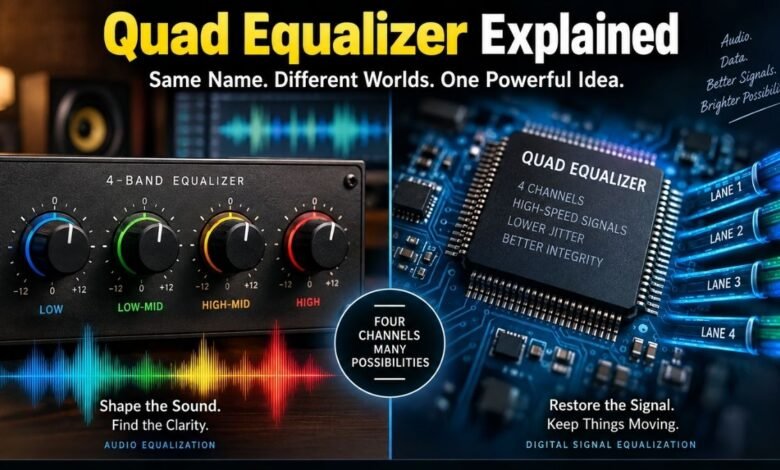
Search for Quad Equalizer and the results can become confusing fast. One page may discuss bass, midrange, treble, frequency, gain, and Q. Another may describe DisplayPort channels, circuit-board traces, jitter, signal loss, or multi-gigabit data rates.
Both can be technically correct.
The reason is simple: “quad” means four, while “equalizer” describes a system that compensates for or adjusts a signal. What those four elements represent depends entirely on the application. Professional audio commonly uses four-band equalization. In older quadraphonic systems, four refers to the number of audio channels. In high-speed electronics, manufacturers use “quad equalizer” for semiconductor devices that condition four digital-data lanes.
BLUF: A Quad Equalizer is not one universally standardized device. In audio, the term commonly describes four-band or four-channel equalization used to shape frequency response. In high-speed electronics, it can describe a four-channel signal equalizer that compensates for transmission losses, jitter, and signal degradation across digital data paths.
The Four-Band Audio Interpretation Most Listeners Will Recognize
For musicians, producers, live-sound engineers, podcasters, and mixer users, a Quad Equalizer will often be understood as a four-band EQ.
A useful real-world example comes from Yamaha’s professional RIVAGE PM mixing system. Yamaha provides a four-band EQ on input channels, arranged as LOW, LOW MID, HIGH MID, and HIGH. The system lets you control frequency, gain, and Q for each band.
That structure demonstrates what a four-band equalizer can provide: more control than a simple bass-and-treble arrangement without requiring dozens of individual filters.
What the four bands actually control
A typical four-band configuration divides tonal adjustment into broad areas:
- Low: bass and low-frequency energy
- Low-mid: body, warmth, or muddiness
- High-mid: intelligibility, attack, presence, or harshness
- Great: brightness and upper-frequency detail
These descriptions are useful guides, not universal frequency assignments. The precise frequency range depends on the hardware, software, filter design, and user settings.
A four-band parametric system may let you move each band across a substantial frequency range rather than permanently assigning one narrow region to each control.
Frequency, gain, and Q are the controls that matter.
Three parameters explain much of modern equalization.
Frequency identifies the part of the spectrum being adjusted.
Gain determines how much that area is boosted or attenuated.
Q, often described through filter bandwidth or steepness, affects how broad or narrow the adjustment becomes.
Shure’s documentation for parametric equalization similarly describes adjustable frequency response and filter types, including parametric, low-cut, low-shelf, high-cut, and high-shelf processing.
That flexibility is why equalization is used for much more than making music sound “bassier” or “brighter.”
What a Quad Equalizer Can Fix—and What It Cannot
Equalization changes the level of selected frequency regions. Used carefully, it can improve clarity and tonal balance.
A Quad Equalizer may help when vocals sound buried, low frequencies feel excessive, certain midrange frequencies dominate a mix, or a source needs tonal adjustment to sit more naturally alongside other instruments.
Professional EQ is also used in speech reinforcement and room-related correction. Shure lists applications such as improving speech intelligibility, reducing certain environmental noises, compensating for room irregularities, and adjusting the frequency response of reinforcement systems.
But EQ has limits.
Equalization doesn’t fix every bad recording.
An equalizer cannot reconstruct information that was never captured correctly.
Severe clipping, strong background noise, microphone distortion, poor source positioning, damaged files, aggressive compression artifacts, and badly recorded reverberation may require different processing—or may be impossible to remove completely.
Aggressively boosting frequencies can also create new problems by increasing unwanted noise or reducing available headroom.
For that reason, effective EQ usually begins with identifying a specific problem instead of randomly moving controls until the audio sounds dramatically different.
Why subtle adjustments often work better
A large boost affects not only the sound you want to emphasize but potentially unwanted material occupying the same frequency region.
If a vocal feels unclear, for example, simply increasing every high-frequency band may make sibilance or cymbals harsher. A more targeted adjustment can often preserve a natural result.
There is therefore no single “best Quad Equalizer setting” for every song, speaker, voice, room, or recording.
Quad Does Not Always Mean Four Frequency Bands
This is where the terminology matters.
A device can contain four channels rather than four EQ frequency bands. Each channel may have its own equalization processing.
That differs from a four-band EQ applied to a single audio channel.
Then there is quadraphonic sound.
Quadraphonic audio refers to four-channel reproduction, an important chapter in the development of multichannel sound. The Library of Congress describes the quadraphonic era as involving four-channel mixes, particularly associated with recordings from the late 1960s through the 1970s.
A quadraphonic equalizer could therefore refer to balancing or processing four playback channels rather than dividing one signal into four frequency regions.
That historical meaning should not be confused with a modern four-band EQ interface.
The Other Quad Equalizer Lives Inside High-Speed Electronics
The biggest source of search confusion comes from semiconductor engineering.
In this field, equalization is not primarily about changing music’s tonal character. It is about maintaining reliable digital communication.
As fast electrical signals travel through printed-circuit-board traces, connectors, cables, and other transmission paths, the signal can deteriorate. Equalization can compensate for frequency-dependent transmission losses and improve the quality of the signal reaching the receiver.
Texas Instruments uses “Quad Equalizer” to refer to four data channels.
Texas Instruments officially describes the DS32EV400 as a DisplayPort Quad Equalizer. TI specifies four channels, operation up to 3.2 Gbps, and programmable equalization designed to compensate for transmission loss. The company lists the device as active in its current product information.
Here, “quad” means four digital channels.
It has nothing to do with bass, vocals, treble, music production, or a four-band graphic EQ.
Analog Devices shows the same terminology in high-speed networking.
Another clear example is the MAX3980, which Analog Devices describes as a 3.125 Gbps XAUI Quad Equalizer.
The device was designed to compensate for transmission-medium losses across four digital NRZ data lanes. Analog Devices states that the component supports four differential lanes at 3.125 Gbps and was designed for applications including 10-Gigabit Ethernet XAUI interfaces.
Its product status also provides useful context: Analog Devices currently labels the MAX3980 as not recommended for new designs, so it is better treated as a technical example than as a default choice for a new engineering project.
These semiconductor examples establish an important point: searching “Quad Equalizer” without context can mix audio tutorials with highly specialized electronics documentation.
Four-Band EQ, Graphic EQ, and Parametric EQ Are Not Interchangeable
Another common misunderstanding involves treating every equalizer with four controls as the same technology.
They are not.
Four-band describes quantity, not necessarily filter architecture.
“Four-band” tells you there are four EQ bands available. It does not automatically reveal how flexible each band is.
A four-band system might use fixed frequencies, sweepable frequencies, shelving filters, peaking filters, or fully parametric controls.
A parametric equalizer generally offers deeper control over parameters such as center frequency, boost or cut, and bandwidth. Shure’s technical material distinguishes parametric equalization from simpler EQ structures by emphasizing its control over frequency, bandwidth, and level.
A graphic equalizer, by contrast, typically provides multiple fixed-frequency filters whose controls visually approximate the frequency-response curve.
So “Quad Equalizer” should never be automatically interpreted as a “four-band graphic equalizer.”
How to Identify Which Quad Equalizer Someone Means
Context usually resolves the ambiguity.
If you see terms such as bass, treble, vocals, gain, Q, Hz, frequency response, mixer, microphone, speakers, recording, or music, the subject is probably audio equalization.
If the discussion includes Gbps, DisplayPort, Ethernet, PCIe, PCB traces, lanes, jitter, redrivers, transmission loss, CML, or signal integrity, it almost certainly refers to digital electronics.
And if the material discusses four speakers, vintage records, discrete channels, 4.0 playback, or 1970s multichannel recordings, it may mean quadraphonic audio.
This simple distinction prevents most misunderstandings surrounding the keyword.
The Meaning Depends on the Signal, Not Just the Name
“Quad Equalizer” looks like a precise technical label, but it only becomes precise once you know the context.
For audio users, it often points toward four-band frequency control: a practical way to shape low, midrange, and high-frequency content with more precision than basic tone controls. For multichannel audio, quad can describe four independent signal paths. For electronics engineers, the same phrase can identify a sophisticated four-lane signal-conditioning component operating at multi-gigabit speeds.
The safest interpretation, then, is not simply “an equalizer with four bands.”
It is an equalization system built around four controllable elements, whose exact purpose depends on the equipment, signal type, and application.
FAQs.
What is a Quad Equalizer?
A Quad Equalizer is an equalization system with four bands, channels, sections, or signal paths, depending on the technical context. In audio equipment, it may describe a four-band or four-channel EQ. In semiconductor engineering, it can describe one chip that equalizes four high-speed digital-data channels.
Is a Quad Equalizer the same as a four-band EQ?
A Quad Equalizer can be a four-band EQ, but the terms are not universally interchangeable. Four-band EQ specifically describes four frequency-adjustment bands. “Quad Equalizer” can also refer to four independent channels, quadraphonic processing, or electronic signal-conditioning devices designed for four digital lanes.
What does a four-band equalizer do?
A four-band equalizer adjusts four regions of an audio signal’s frequency response. Professional implementations may provide low, low-mid, high-mid, and high bands, with controls for frequency, gain, and Q. The exact frequencies and filter behavior depend on the mixer, processor, plug-in, or hardware design.
What is the best Quad Equalizer setting?
There is no universal best Quad Equalizer setting because correct EQ depends on the source, microphone, speakers, room, recording, and intended result. A good starting point is a neutral or flat setting, then make small adjustments to fix clearly audible problems instead of automatically boosting every band.
Is a Quad Equalizer the same as a Quad DAC?
No. A Quad Equalizer and Quad DAC describe different functions. Equalization modifies or compensates for a signal’s characteristics. A DAC performs digital-to-analog conversion. A product containing multiple DAC elements therefore should not automatically be described as a four-band or four-channel equalizer.
Why are Quad Equalizers used in digital electronics?
A digital Quad Equalizer compensates for signal degradation across four high-speed data channels. Transmission through PCB traces or cables can introduce frequency-dependent loss and distortion. Devices such as TI’s DS32EV400 and Analog Devices’ MAX3980 use equalization to improve received signal quality across multiple lanes.