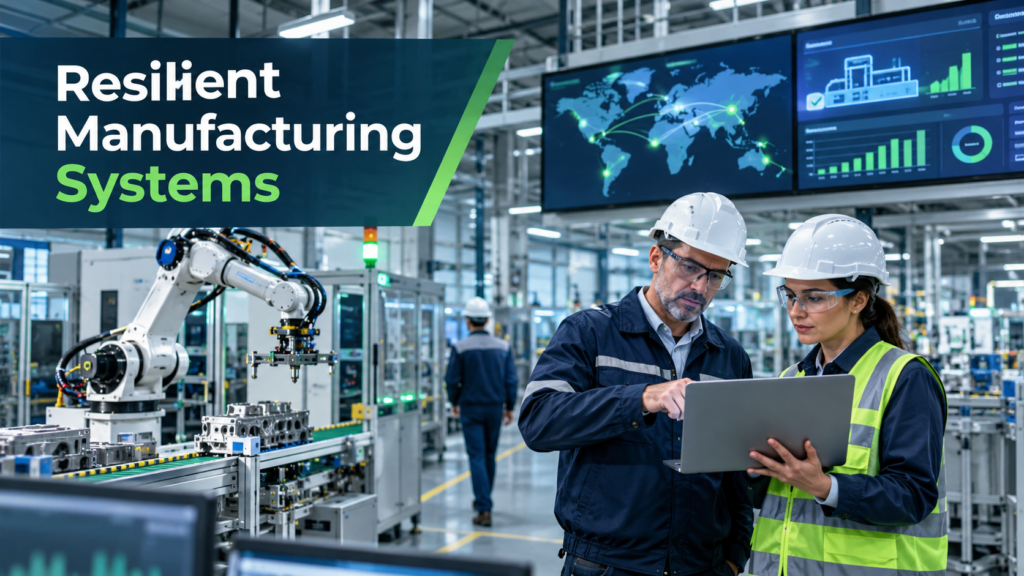
Manufacturing resilience is no longer a separate planning exercise reserved for major disruptions. It is an operating discipline that helps industrial companies protect delivery, quality, safety, and customer trust when conditions change. Leaders can learn from the operational focus associated with experienced executives such as Louis Chenevert, whose career reflects the importance of disciplined production systems and supply chain execution.
In 2026, resilient manufacturers are preparing for more than one type of risk. Material shortages, supplier failures, cyber incidents, equipment problems, skilled labor gaps, transportation delays, and changing trade conditions can each interrupt production. The goal is not to eliminate every risk. It is to recognize the risks that matter most, respond quickly, and recover without compromising quality.
Why Manufacturing Resilience Matters
Efficiency remains important, but the lowest-cost operating model is not always the most dependable one. A plant can run efficiently under normal conditions while still being vulnerable to one unavailable component, a delayed approval, or a machine failure with no spare parts. Resilience adds the capacity to absorb disruption and restore stable performance.
That requires leaders to look beyond their own facilities. The supply chain pressures facing business leaders reinforce the need to connect risk planning with talent, technology, suppliers, and operating decisions. A disruption at a lower-tier supplier can eventually stop a finished-goods line, especially when a part is specialized or difficult to qualify elsewhere.
The Core Elements Of A Resilient Factory
A resilient factory is built on several connected capabilities:
- Visibility: Teams can see inventory, production status, supplier commitments, and delivery priorities.
- Flexibility: The operation can adjust schedules, volumes, routes, or sources when needed.
- Speed: Problems reach the right decision-makers before they become expensive outages.
- Quality: Recovery plans preserve specifications, traceability, and customer requirements.
- People: Workers have the skills and authority to identify and solve process issues.
- Governance: Leaders define ownership, escalation paths, and decision rights.
Step One: Audit Operational Risk
Before buying equipment or launching a software program, create a practical risk map. Start by listing critical products, materials, machines, tools, suppliers, data systems, and specialized roles. For each one, assess the likelihood of disruption, the probable cost of downtime, available backup options, and expected recovery time.
Questions That Make The Audit Useful
- Which single-source components could stop production?
- Which machines depend on aging controls or unavailable replacement parts?
- Where does one technician hold knowledge that no one else can provide?
- Which customer commitments would be hardest to recover after a missed shipment?
Assign an owner to every significant risk and revisit the map at least quarterly. The exercise should lead to action, not become a static spreadsheet.
Step Two: Strengthen The Supplier Network
Supplier diversification does not mean replacing every incumbent vendor or duplicating every purchase order. It means identifying the parts, materials, and services where backup capacity is worth the added effort. For critical inputs, qualify a second source where feasible, monitor supplier capacity and financial health, and understand important lower-tier dependencies.
Better collaboration also improves continuity. Sharing realistic forecasts, discussing constraints early, and defining escalation contacts can help suppliers plan. Regional sourcing may be appropriate when shorter lead times and continuity outweigh modest unit-cost savings. Inventory should be targeted as well. Holding additional stock can protect a true bottleneck, but unmanaged inventory can create cash, storage, and obsolescence problems.
Step Three: Choose Technology With Care
Technology can improve resilience when it helps teams detect, decide, or act faster. Sensors can support condition monitoring, manufacturing software can improve scheduling visibility, and digital models can help teams test production changes before disrupting the floor. Artificial intelligence and robotics should be evaluated against a clear business problem, not adopted simply because they are available.
Smaller firms can also seek practical guidance through programs that support advanced technology adoption. Recent funding for Manufacturing Extension Partnership centers illustrates the role these organizations can play in helping manufacturers explore automation, robotics, additive manufacturing, and related capabilities.
Technology Questions To Ask
- What operational problem will this solve?
- Can it connect reliably with current systems and workflows?
- What cybersecurity, maintenance, and training requirements come with it?
- How will the team measure value after the pilot?
Step Four: Prepare The Workforce
New tools only create value when people can use and improve them. Build short, role-specific training for operators, maintenance teams, quality staff, and supervisors. Pair experienced employees with newer workers, teach supervisors how to interpret operational data, and include cybersecurity and safety in everyday instruction.
Frontline workers should also have a simple way to raise concerns and improvement ideas. They often notice variation, wear, awkward handoffs, and recurring quality problems before those issues appear in a dashboard.
Step Five: Build A Clear Leadership Rhythm
Resilience becomes durable when risk review is part of normal management. Hold brief daily discussions for immediate production constraints, review supplier and inventory risks weekly, examine capital and technology projects monthly, and conduct broader resilience reviews each quarter. Every decision should have an owner, a deadline, and a defined follow-up point.
Metrics That Show Real Progress
A useful scorecard is focused enough to drive action. Track measures such as unplanned downtime, first-pass yield, order fulfillment, supplier defect rates, supplier concentration, inventory accuracy, maintenance response time, employee training completion, and average recovery time after a disruption. Review quality and safety alongside speed so teams do not solve one problem by creating another.
Common Mistakes To Avoid
- Buying technology before defining the operational problem.
- Reviewing only direct suppliers while ignoring lower-tier dependencies.
- Treating workforce training as a one-time event.
- Adding inventory without a clear demand, storage, and obsolescence plan.
- Assuming a successful pilot will scale without process redesign.
- Keeping risk information isolated within separate departments.
Conclusion
Resilient manufacturing systems are built through steady, connected choices. Start with the risks that could cause the greatest operational harm. Strengthen the supplier relationships that support critical production, invest in technology with a measurable purpose, prepare the workforce, and maintain a leadership rhythm that turns information into action. Companies do not need to change everything at once. Focused improvements, repeated consistently, can make a factory more adaptable without sacrificing quality, safety, or trust.