LabelEU Is Preparing Businesses for Europe’s Product-Passport Era—Here’s What the Platform Actually Does
With the EU's Digital Product Passport infrastructure now operational and the first binding battery deadline approaching, LabelEU is positioning itself as a practical compliance workspace for businesses that need product data, QR codes, and passport publishing without building the technology from scratch.

Europe’s product-compliance system is becoming increasingly digital. That shift moved from policy to infrastructure on 20 July 2026, when the European Commission made its Digital Product Passport Registry operational. The registry indexes Digital Product Passports, or DPPs, for products that fall under applicable EU requirements.
For manufacturers, importers and brands, the critical question is no longer simply whether Digital Product Passports are coming. It is which products require them, when the legal obligation begins, and how companies will collect, structure, and publish the necessary information.
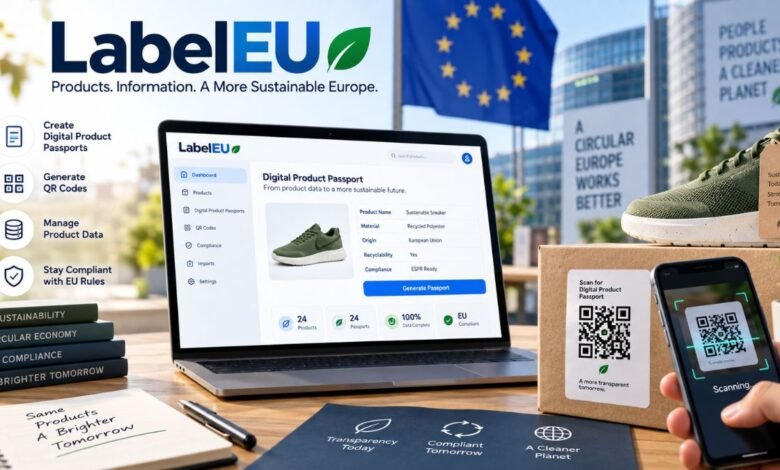
That is the problem LabelEU is attempting to solve. Its public platform describes a SaaS system for creating, managing and publishing Digital Product Passports, alongside product labels, QR codes, structured compliance fields and data-import tools.
BLUF: LabelEU is a Digital Product Passport platform designed to help businesses organize product information, create QR-linked passport pages and prepare data around EU requirements. It is not an EU authority or automatic proof of compliance; the underlying manufacturer or economic operator remains responsible for accurate product information and applicable legal obligations.
LabelEU at a Glance
- Platform type: Software-as-a-Service for Digital Product Passports
- Primary focus: EU product-compliance preparation
- Core technology: QR-linked digital product records
- Supported workflow: Product data entry, passport generation and label preparation
- Bulk data options: CSV, Excel, and Shopify-oriented importing are described by the platform
- Public passport hosting: Available as part of the service architecture
- Regulatory focus: ESPR, battery rules and related EU product legislation
- Current regulatory milestone: EU DPP Registry operational since 20 July 2026
Why LabelEU Suddenly Matters More in 2026
The timing is significant.
Regulation (EU) 2024/1781, known as the Ecodesign for Sustainable Products Regulation, established the broader Digital Product Passport framework. Article 9 states that products covered by applicable delegated acts can only be placed on the market or put into service when the required Digital Product Passport is available.
That does not mean every physical product sold in Europe already requires a passport.
The legal obligation depends on the relevant product legislation or an ESPR delegated act covering a specific product group. This distinction matters because businesses can easily confuse the DPP framework with an immediate passport requirement for all products.
The EU has also created the technical infrastructure behind the system. Article 13 of the ESPR required the European Commission to establish a registry storing at least unique product identifiers by July 2026, and the Commission subsequently made the DPP Registry operational on 20 July 2026.
The Registry Is an Index, Not the Entire Product Passport
The European Commission describes the DPP Registry as an indexing service.
It stores unique identifiers, registration information, and certain high-level metadata rather than necessarily holding every piece of detailed product information contained inside a passport. The detailed DPP can remain decentralized under the responsibility of the relevant economic operator or an appropriate service provider.
That architecture creates a clear need for software that can maintain the underlying passport information while still producing identifiers and records compatible with regulatory infrastructure.
LabelEU is targeting that layer.
What Businesses Can Actually Do With LabelEU
The platform’s public demo shows a guided product editor where businesses can enter information such as product category, product name, materials, origin, recycled content, care instructions, recyclability details, and selected compliance information.
A typical workflow is presented as three steps:
- Enter or import product information.
- Generate a Digital Product Passport.
- Create a QR code or printable product label.
This matters because a DPP is not simply a QR code.
The QR code or another permitted data carrier acts as an entry point. The real compliance workload involves maintaining structured product information that remains accessible, accurate, and appropriately linked to the relevant product identifier.
Product Information Can Go Beyond a Basic Label
Depending on the relevant legislation, DPP information can concern matters such as:
- product identity;
- manufacturer or economic-operator details;
- material composition;
- supply-chain or origin information;
- repair or maintenance information;
- substances of concern;
- environmental characteristics;
- recycling instructions;
- technical documentation;
- compliance information.
The exact mandatory fields depend on the legislation governing the product category. Businesses should therefore not assume one universal DPP template automatically satisfies every sector.
LabelEU itself distinguishes between legally required data and platform guidance in portions of its demo, an important distinction for companies using automated compliance tools.
The Compliance Calendar Businesses Should Watch
Product or SystemCurrent PositionKey Date
EU DPP Registry Operational 20 July 2026
Certain batteries Battery passport legally required 18 February 2027
Toys Digital Product Passport requirement applies with the new Toy Safety Regulation 1 August 2030
ESPR product groups Requirements depend on product-specific delegated acts Varies by product group
The 18 February 2027 battery deadline is particularly important because it is not merely a proposed milestone.
Article 77 of Regulation (EU) 2023/1542 states that from that date, every light means of transport battery, electric-vehicle battery, and industrial battery with capacity greater than 2 kWh that falls within the provision must have an electronic battery passport.
That makes batteries one of the clearest near-term DPP use cases.
Toys Follow on a Different Legal Track
The new Toy Safety Regulation creates another major Digital Product Passport requirement.
Regulation (EU) 2025/2509 states that manufacturers must create a Digital Product Passport before placing a toy on the market under the relevant regime. The regulation generally applies from 1 August 2030, after its transitional period.
The European Commission says the passport will contain safety and compliance information and will be accessible through a QR code or another data carrier.
A Short Timeline of the DPP Shift
13 June 2024 — ESPR adopted: Regulation (EU) 2024/1781 establishes the legal framework supporting Digital Product Passports.
26 November 2025 — Toy Safety Regulation adopted: Regulation (EU) 2025/2509 introduces a Digital Product Passport regime for toys.
16 July 2026 — DPP Registry implementing rules adopted: Commission Implementing Regulation (EU) 2026/1778 establishes operational arrangements covering the registry.
20 July 2026 — EU DPP Registry becomes operational: Businesses gain access to the Commission’s registry environment and supporting resources.
18 February 2027 — Battery passport obligation: Relevant EV, LMT and industrial batteries above 2 kWh require electronic battery passports.
1 August 2030 — Toy rules generally apply: The new Toy Safety Regulation, including its DPP framework, becomes applicable.
LabelEU Pricing Needs One Important Qualification
LabelEU publishes planned passport-pack pricing, but its pricing page currently says those packs are not being sold yet.
The displayed model lists:
Planned Pack Passports Displayed Price
Starter 5 €50
Growth 25 €199
Scale 100 €699
LabelEU says these figures represent what the packs would cost, not a currently available purchase offer. It also advertises three free draft passports for users exploring the system.
That qualification matters. Reporting these prices as currently purchasable subscriptions or products would misrepresent the platform’s present commercial status.
The proposed structure is unusual compared with traditional recurring SaaS pricing because LabelEU describes the planned passport credits as cumulative and non-expiring. Whether the final commercial model remains unchanged should be checked directly before purchasing decisions are made.
Where LabelEU May Fit Inside a Company’s Compliance Process
LabelEU seems most relevant to businesses that understand they need structured product information but don’t want to build an entire DPP technology stack internally.
A small manufacturer, for example, could otherwise need to coordinate:
- product databases;
- unique identifiers;
- consumer-facing passport pages;
- QR generation;
- data hosting;
- regulatory field mapping;
- downloadable labels;
- version management;
- bulk product importing.
Bringing those functions into a single interface can reduce operational complexity.
However, software cannot replace accurate source data.
If a manufacturer enters an incorrect material composition, misleading environmental claim, or incomplete technical record, turning that information into a polished Digital Product Passport does not make the underlying statement correct.
This matters because the EU framework requires DPP information to be accurate, complete, and up to date where applicable.
The Bigger Shift Is From Static Labels to Structured Product Data
The most important part of the DPP transition may not be the QR code consumers eventually see.
It is the movement toward persistent, structured, and interoperable product information.
The European Commission says the DPP Registry supports unique identifiers and metadata while the broader architecture allows detailed product information to remain decentralized. That means manufacturers increasingly need systems that keep product records accessible throughout relevant portions of a product’s lifecycle.
For companies with hundreds or thousands of SKUs, this can become a data-management project long before it becomes a printing project.
LabelEU’s strongest practical proposition is therefore not simply “create a QR code.” The more consequential use case is preparing product information in a structured environment before sector-specific legal obligations become applicable.
The Real Test for LabelEU Comes as EU Deadlines Turn Binding
LabelEU is arriving at a consequential point in European product regulation.
The policy architecture already exists. The Commission’s DPP Registry is operational. The first major battery deadline is scheduled for 18 February 2027, and further sector-specific obligations are expected to expand the practical relevance of Digital Product Passports over time.
For businesses, the useful question is not whether a QR-code generator looks convenient. It is whether their product information is complete, accurate, maintainable, and structured well enough to satisfy the legislation that actually applies to their sector.
That is where platforms such as LabelEU will ultimately be judged: not by the appearance of the passport page, but by how reliably they help businesses connect complex product data with an increasingly digital EU compliance system.
FAQs
What is LabelEU?
LabelEU is a Software-as-a-Service platform focused on creating, managing, and publishing Digital Product Passports. Its public tools combine structured product-data entry, passport pages, QR-code generation, label design, and importing capabilities intended to help businesses prepare for European product-information requirements.
Is LabelEU an official European Union platform?
No. LabelEU is a separate software service, while the European Commission operates the official Digital Product Passport Registry. Businesses should distinguish a commercial DPP provider from the EU infrastructure that registers identifiers and relevant metadata under applicable legislation.
Does every product sold in the EU need a Digital Product Passport in 2026?
No. The ESPR establishes the framework, but passport obligations depend on applicable product-specific legislation or delegated acts. Certain batteries have a binding passport date of 18 February 2027, while the new toy regime generally applies from 1 August 2030.
Does using LabelEU automatically make a product legally compliant?
No. A DPP platform can help organize and publish information, but legal compliance ultimately depends on the applicable legislation and the accuracy of the manufacturer’s or economic operator’s product data. LabelEU’s public passport materials state that manufacturer-declared data remains the economic operator’s responsibility.
What is the first major Digital Product Passport deadline businesses should watch?
For the regulations discussed here, 18 February 2027 is a major immediate deadline. Article 77 of the EU Battery Regulation requires electronic battery passports for EV batteries, light-means-of-transport batteries and industrial batteries above 2 kWh covered by that provision.
Is LabelEU already charging for Digital Product Passports?
Its current pricing page says no passport packs are presently on sale. It publishes intended prices for Starter, Growth and Scale packs while offering free draft-passport functionality. Those published figures should therefore be treated as proposed pricing rather than an active purchase offer.
Editorial Disclaimer
This feature reflects publicly available information and EU legislation checked in September 2026. Digital Product Passport requirements vary by product category, legislation, delegated acts and implementation dates. LabelEU is a third-party commercial service, not an EU regulatory authority. Businesses should verify the legislation applicable to their specific products and should not treat software-generated compliance indicators as a substitute for legal or regulatory advice.