Counter-Strike Jobs Are Real — But the Career Paths Look Nothing Like a Normal Job Search
From professional play and coaching to software engineering, tournament production, content, QA, and community work, the Counter-Strike economy supports far more roles than most players ever see.

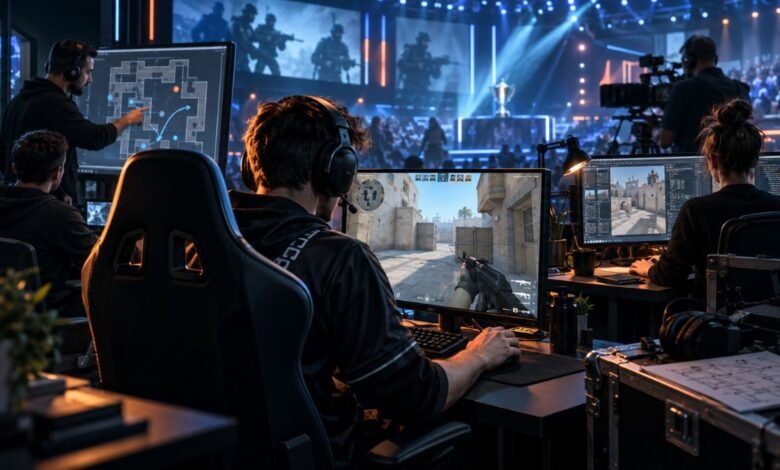
Searching for Counter-Strike jobs sounds simple. The results are not. A search can surface everything from professional Counter-Strike 2 opportunities to unrelated retail “counter” positions, making it surprisingly hard to understand what a real CS2 career looks like.
The timing matters. Counter-Strike 2 remains actively developed by Valve, with official updates continuing through 2026, while professional tournaments, teams, media operations, and third-party platforms create work far beyond the five players visible on stage. Valve’s July 29, 2026 update, for example, still tied the game directly to its competitive ecosystem through the Cologne 2026 Major and revenue-sharing tournament items.
For job seekers, that creates an unusual market: there is no single “Counter-Strike profession.” Instead, CS2-related work spans game development, esports competition, broadcasting, analytics, content creation, event production, community management, and testing.
BLUF: Counter-Strike jobs are paid roles connected to Counter-Strike 2 through professional competition, coaching, analysis, broadcasting, content, game development, QA, tournament operations, or community work. The strongest candidates combine a specialized professional skill with genuine CS2 knowledge rather than relying on gaming ability alone.
The Search Term Hides Several Completely Different Job Markets
One of the first problems with the keyword counter strike jobs is search ambiguity.
General employment platforms sometimes interpret the words independently rather than recognizing Counter-Strike as Valve’s game franchise. A recent ZipRecruiter page targeting “Counter Strike Jobs,” for example, surfaced jobs including a Lucky Strike Entertainment counter-desk position and an industrial counter-sales role—neither is a Counter-Strike 2 career.
Anyone seriously looking for work in the CS2 ecosystem should therefore search by role plus game, rather than relying on the broad phrase alone.
Useful searches include:
- Counter-Strike 2 esports jobs
- CS2 tournament jobs
- Counter-Strike analyst jobs
- CS2 coach vacancies
- Counter-Strike video editor
- CS2 social media manager
- esports observer Counter-Strike
- CS2 QA tester
- Counter-Strike content creator jobs
- Valve game development careers
- esports production jobs
- Counter-Strike community manager
That distinction immediately produces a more realistic picture of the employment market.
The important pattern is clear: Counter-Strike knowledge is normally an advantage layered on top of another professional skill.
Being Good at CS2 Is Only One Way to Get Paid
Being a professional player is the most visible Counter-Strike career, but it is also one of the narrowest routes.
A competitive player needs considerably more than a high Premier rating. Team-level Counter-Strike requires communication, utility knowledge, positioning, map preparation, role discipline, practice routines, and the ability to perform consistently against structured opposition.
Counter-Strike 2 gives competitive players measurable systems, including CS Rating, Premier mode, and global and regional leaderboards. Valve describes CS Rating as a visible measurement of Counter-Strike performance used for its leaderboards.
Those systems can show individual ability, but professional organizations evaluate more than leaderboard position.
Coaches Turn Game Knowledge Into Structured Performance
Coaching is a different skill.
A CS2 coach may help organize practice, study opponents, review demos, prepare map vetoes, identify repeated mistakes, and establish tactical systems. Team management and communication can be as important as raw game knowledge.
The professional scene also shows that coaching and analysis can become distinct career tracks. Competitive Counter-Strike maintains separate player, analyst, and coaching roles rather than treating every former player as simply another competitor.
For someone who understands CS2 deeply but lacks professional-level mechanical skill, coaching or analysis can be a more realistic specialization.
Analysts Make Information Useful
Analysts work with patterns.
Depending on the organization, the role may include reviewing demos, identifying opponent tendencies, studying utility usage, analyzing opening engagements, preparing map-specific reports, or supporting coaches with structured information.
The key qualification is not simply “watching a lot of Counter-Strike.”
An analyst must convert matches into information that a player or coach can actually use.
The Broadcast Crew Creates Careers Viewers Rarely Notice
A Counter-Strike event involves far more people than the ten players inside the server.
Major broadcasts can require:
- Casters
- Analysts
- Hosts
- Reporters
- Observers
- Producers
- Replay operators
- Audio staff
- Video teams
- Graphics operators
- Technical staff
- Tournament administrators
The 2026 Esports World Cup Counter-Strike broadcast talent, for example, included separate hosts, analysts, commentators, and reporters, illustrating how specialized professional-event coverage has become.
What Does a Counter-Strike Observer Do?
An observer controls what the audience sees during a match.
That sounds straightforward until five players execute onto a bombsite while grenades, rotations and opening duels happen almost simultaneously.
A strong observer anticipates action rather than merely reacting. Deep knowledge of rotations, utility, economy and player tendencies helps determine which perspective should appear on screen.
Specialized esports software is even being developed around this function. LHM, for example, markets CS2 broadcast technology that includes automated observing, cinematic camera tools and broadcast features for tournament production.
Technology may change the observer’s workflow, but understanding live Counter-Strike remains valuable.
Valve Careers Show Where CS2 Meets Traditional Game Development
Not every Counter-Strike career belongs to esports.
Counter-Strike 2 is also a software product built and maintained inside Valve’s wider game-development organization.
Valve says it does not usually hire around conventional job titles because of its organizational structure, but its careers material lists disciplines including:
- 3D Character Artist
- Animator
- Effects Artist
- 3D Environment Artist
- Sound Designer
- Level Designer
- Game Development Software Engineer
- Computer Vision Software Engineer
- Audio Software Engineer
- Visual and User Experience Design
- Data Science
- Technical Infrastructure
Valve says it looks for people with broad skill sets combined with deep expertise.
That distinction is important.
Playing thousands of hours of Counter-Strike does not automatically qualify someone to become a Valve developer. A software-engineering applicant still needs serious engineering ability. An environment artist needs a professional art portfolio. A level designer needs demonstrable design expertise.
CS2 familiarity can strengthen relevant domain understanding, but it does not replace the underlying profession.
Maps and Workshop Skills Can Become a Serious Portfolio
Counter-Strike’s community tools create another route into the ecosystem.
CS2 uses Source 2, and Valve describes the game as offering upgraded Community Workshop tools alongside its modernized rendering and networking technology.
Community-created maps also continue to enter official updates. Valve’s 2026 update logs repeatedly document changes to Workshop and community maps, including Boulder, Fachwerk, Shelter, and others.
For an aspiring level designer, this provides something particularly useful: a public portfolio opportunity.
Instead of writing:
“I understand Counter-Strike map design.”
a candidate can demonstrate:
- A playable map
- Bombsite design
- Rotation timings
- Sightline decisions
- Lighting
- Collision work
- Performance optimisation
- Player feedback
- Iterative updates
That evidence is far stronger than simply listing CS2 as a hobby on a résumé.
Real 2026 Listings Show How Broad the Market Can Be
Current opportunities illustrate why “Counter-Strike jobs” should not be interpreted as one occupation.
A Pwnage eSports listing published on August 31, 2026 sought Counter-Strike 2 players to test the GoBLAM tournament platform. The remote, temporary part-time opportunity required a Steam account with at least 20 hours of CS2, English reading and writing ability, a personal computer, a minimum age of 18, and residence in specified UK or European locations. The listing advertised €15 per testing session, with each session estimated at roughly 90 minutes, including play and feedback.
That is closer to product testing and QA than professional esports.
Another current example comes from German esports organization Entropy. Its jobs page advertises Counter-Strike 2-focused content work, including social-media activity and video editing. The video role focuses on short-form CS2 content for platforms such as X, Instagram, and TikTok, with an indicated workload of about five to six hours per week and home-office work.
These examples show how someone can work around Counter-Strike without being signed as a professional player.
A Practical Route Into Counter-Strike Jobs
The most effective strategy is to stop asking, “How do I get a Counter-Strike job?” and instead ask:
“Which professional skill can I prove inside Counter-Strike?”
Route 1: Competitive Play
Build evidence through:
- Structured team experience
- League and tournament participation
- Consistent performance
- Demo review
- Clear communication
- Networking with legitimate teams
A leaderboard position can help, but organized team results are generally more relevant to team-based competition.
Route 2: Coaching or Analysis
Create sample work.
Analyze a professional match and produce:
- Map-veto analysis
- CT defensive patterns
- T-side opening tendencies
- Economy decisions
- Utility packages
- Positioning mistakes
- Actionable adjustments
The objective is to demonstrate thinking, not simply opinions.
Route 3: Content
Choose one format and publish consistently:
- Tactical breakdowns
- Patch explanations
- Match analysis
- Highlight edits
- Short-form clips
- Player interviews
- News reporting
- Utility guides
A portfolio with ten strong pieces is more useful to an employer than saying you are “passionate about esports.”
Route 4: Development
Build the underlying technical skill first.
Depending on the target job, this could mean:
- C++
- Game programming
- 3D modelling
- Environment art
- Level design
- Sound design
- UI/UX
- Networking
- Data analysis
Then create projects relevant to FPS games or Counter-Strike.
Route 5: Tournament Production
Small tournaments can provide valuable experience.
Potential entry-level responsibilities include match administration, brackets, Discord support, social media, statistics, observing, streaming, and production assistance.
The goal is to build a track record of reliably running competitive events.
The Biggest Mistake: Treating Gaming Hours as a Qualification
Ten thousand hours of Counter-Strike may demonstrate commitment.
It does not automatically demonstrate employability.
An employer hiring a video editor wants editing ability. A tournament operator needs organizational reliability. A team needs a coach who can communicate and prepare. A developer needs technical competence.
The strongest applicant combines both sides:
Professional skill + Counter-Strike expertise = a credible CS2 career profile.
An esports organization can use someone with excellent video-editing skills who understands Counter-Strike timing, terminology, and player culture more easily than someone who knows CS2 but has never produced professional video.
The same principle applies throughout the ecosystem.
Job Seekers Should Watch for Fake or Misleading Listings
Gaming careers attract inexperienced applicants, which also creates opportunities for misleading recruitment.
Several checks are sensible before accepting a Counter-Strike-related job:
- Verify the organization’s official website.
- Confirm that the recruiter represents the organization.
- Read compensation terms carefully.
- Check whether the role is employment, freelance work, volunteer work, or a temporary gig.
- Never assume “esports opportunity” means a salaried professional position.
- Be cautious when a recruiter requests payment from applicants.
- Avoid sharing Steam credentials or account passwords.
- Confirm country, age, and work-eligibility restrictions.
- Keep screenshots or copies of agreed compensation and responsibilities.
The broad search term itself deserves caution. As noted earlier, generic job aggregators can return positions that are completely unrelated to Counter-Strike 2.
The Opportunity Is Bigger Than the Five Players on the Server
The phrase Counter-Strike jobs can create the wrong mental picture.
Professional play is only the visible edge of the industry.
Behind every serious Counter-Strike product, team, or tournament sits a network of programmers, designers, coaches, analysts, producers, observers, editors, administrators, presenters, and community specialists. Current 2026 listings even show short-term testing and part-time content opportunities that require CS2 knowledge without requiring professional-player status.
For anyone trying to enter the field, the most useful question is therefore not whether Counter-Strike can become a career.
It is which marketable skill you can bring to Counter-Strike—and what portfolio proves you can already do the work.
FAQs
Can playing Counter-Strike 2 actually be a job?
Yes. A professional Counter-Strike 2 player is a legitimate esports occupation, but only a small proportion of players reach salaried or consistently paid competition. Other CS2 careers include coaching, analysis, broadcasting, tournament work, QA, content creation, software development, and community management.
How do I get a job working on Counter-Strike itself?
Working directly on Counter-Strike requires professional game-development skills. Valve currently lists disciplines including level design, game-development software engineering, animation, environment art, effects, sound design, and other technical fields. Valve emphasizes deep expertise rather than simply familiarity with one game.
Are there remote Counter-Strike jobs?
Yes. Some CS2-related roles can be remote, particularly content creation, video editing, social media, platform testing, and certain esports support functions. A 2026 Pwnage eSports testing listing was remote/hybrid, while Entropy advertised CS2 content work with a home-office arrangement. Availability depends heavily on country and employer.
Do I need to be a professional player to work in Counter-Strike esports?
No. Counter-Strike esports employs specialists who are not professional players. Major broadcasts use commentators, analysts, hosts, and reporters, while events can also require observers, tournament administrators, producers, technicians, and content teams. Competitive knowledge can still be essential even when playing isn’t the employee’s primary job.
What qualification is best for Counter-Strike jobs?
There is no single Counter-Strike qualification. The best qualification depends on the role. Programming suits engineering, editing portfolios suit content production, tournament experience suits operations, while deep tactical knowledge supports coaching and analysis. Demonstrable work normally provides stronger evidence than simply stating that you enjoy CS2.
Where should I search for Counter-Strike jobs?
Search game-industry career sites, esports organizations, tournament operators, and official company career pages. Use specific searches such as “CS2 video editor,” “Counter-Strike esports analyst,” “CS2 tournament administrator” or “Counter-Strike QA tester.” Broad searches can produce unrelated jobs because search systems may misinterpret the word “counter.”
The Opportunity Is Bigger Than the Five Players on the Server
The phrase counter strike jobs can create the wrong mental picture.
Professional play is only the visible edge of the industry.
Behind every serious Counter-Strike product, team, or tournament sits a network of programmers, designers, coaches, analysts, producers, observers, editors, administrators, presenters, and community specialists. Current 2026 listings even show short-term testing and part-time content opportunities that require CS2 knowledge without requiring professional-player status.
For anyone trying to enter the field, the most useful question is therefore not whether Counter-Strike can become a career.
It is which marketable skill you can bring to Counter-Strike—and what portfolio proves you can already do the work.
Editorial Disclaimer
Job vacancies, compensation, eligibility requirements, tournament rosters and employer needs can change without notice. Examples in this article were verified against publicly accessible sources available on September 17, 2026, and should not be interpreted as permanent vacancies or guaranteed income. Applicants should confirm current terms directly with the relevant organization before applying.