Zettabyte Explained: Meaning, Size, Examples, and Its Importance in the Digital World
Discover what a zettabyte is, how much data it represents, and why this enormous unit of digital storage matters in the age of artificial intelligence, cloud computing, and global connectivity.

Introduction to Zettabyte
The digital world is expanding at an extraordinary pace. Every second, people create, share, store, and process enormous amounts of information through smartphones, websites, social media, businesses, and connected devices. As digital information continues to grow, traditional measurements such as megabytes, gigabytes, and terabytes are no longer sufficient to describe the largest collections of data. This is where the zettabyte becomes important.
A zettabyte (ZB) is an incredibly large unit of digital information used to measure enormous quantities of data. It is particularly useful when discussing global internet activity, cloud infrastructure, enterprise storage, and worldwide data generation. Understanding zettabytes helps explain the scale of modern technology and the challenges associated with managing information in an increasingly connected society.
What Is a Zettabyte?
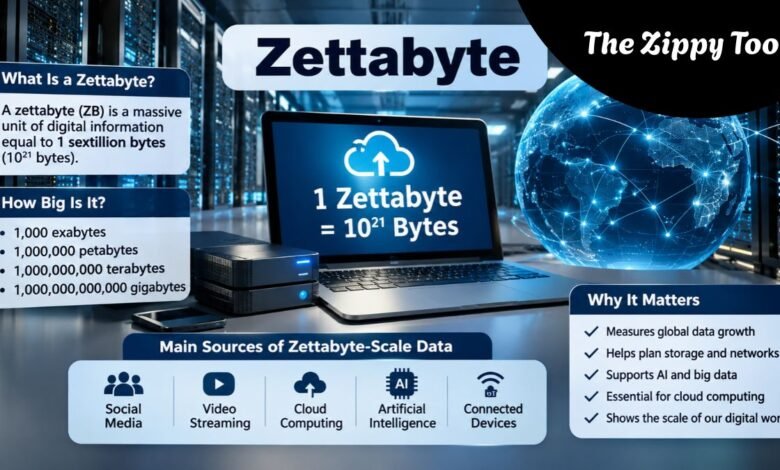
A zettabyte is a standard decimal unit of digital information equal to one sextillion bytes, or 1,000,000,000,000,000,000,000 bytes. In scientific notation, this quantity is represented as 10²¹ bytes. The unit belongs to the International System of Units (SI) decimal prefix system, where each larger unit represents one thousand times the previous unit.
The abbreviation for zettabyte is ZB. It is commonly used in discussions about extremely large datasets, global digital storage capacity, internet traffic, and technological development. Although individual computers and smartphones usually measure storage in gigabytes or terabytes, zettabytes provide a practical way to express the total volume of information produced or handled across massive digital systems.
Unlike smaller storage units, a zettabyte is rarely associated with a single consumer device. Instead, it describes information distributed across vast networks of servers, data centers, devices, and online platforms.
How Big Is a Zettabyte?
To understand the true size of a zettabyte, compare it with more familiar storage measurements. A single gigabyte can hold a substantial collection of documents, photographs, or other digital files. A terabyte equals 1,000 gigabytes and is commonly associated with computer hard drives and external storage devices. A petabyte equals 1,000 terabytes, while an exabyte equals 1,000 petabytes.
A zettabyte is even larger, containing 1,000 exabytes, 1 million petabytes, 1 billion terabytes, or 1 trillion gigabytes. These relationships demonstrate why the unit is useful for discussing worldwide data activity rather than ordinary personal storage.
Consider a hypothetical collection of one-megabyte digital photographs. Using decimal units, one zettabyte would represent approximately one quadrillion such images. This example illustrates the extraordinary scale involved, although actual photograph sizes vary depending on resolution, format, and compression.
The enormous capacity of a zettabyte also helps explain why large-scale data management requires sophisticated computing systems, advanced networking technologies, and extensive storage infrastructure.
Zettabyte vs Zebibyte: Understanding the Difference
One important distinction in digital storage terminology is the difference between a zettabyte (ZB) and a zebibyte (ZiB). Although both describe enormous quantities of digital information, they use different mathematical systems.
A zettabyte follows the decimal system and equals 10²¹ bytes. A zebibyte follows the binary system and equals 2⁷⁰ bytes, or approximately 1.18 sextillion bytes. As a result, one zebibyte is larger than one zettabyte.
This distinction matters because computer technologies frequently involve both decimal and binary measurements. Storage manufacturers generally use decimal units when advertising capacity, while certain operating systems and computing applications use binary-based measurements.
Understanding the difference prevents confusion when comparing storage capacities, interpreting technical specifications, or analyzing enormous datasets. Accurate terminology becomes especially valuable in enterprise computing, scientific research, and large-scale information management.
Why Zettabytes Matter in Today’s Digital World
The importance of zettabytes becomes clearer when examining the growing dependence on digital information. Modern communication, entertainment, commerce, education, healthcare, and scientific research all rely heavily on data collection and processing.
Every online transaction, video stream, digital photograph, internet search, and connected device contributes to the wider digital environment. Individually, these activities may generate relatively modest amounts of information. Collectively, however, they contribute to immense volumes of data.
Zettabyte-scale measurements allow researchers, technology companies, and infrastructure planners to discuss these quantities in understandable terms. They also help organizations estimate future storage needs, network capacity, energy consumption, and data-processing demands.
The concept is particularly relevant to cloud computing and artificial intelligence, where large datasets must be stored, accessed, and analyzed efficiently.
How Is Zettabyte-Scale Data Generated?
Social Media and Online Communication
Social media platforms generate massive quantities of digital information through photographs, videos, messages, comments, and user interactions. Video-sharing services and messaging applications continuously handle new content, while older information may remain stored for extended periods.
Millions of users interacting across digital platforms create a constant flow of information. Worldwide, these activities contribute significantly to the growth of digital data.
Video Streaming and Digital Entertainment
High-definition video, ultra-high-definition streaming, online gaming, and digital entertainment involve substantial amounts of information. Video files can require considerably more storage than ordinary text documents, especially when recorded at high resolutions and bitrates.
Streaming platforms must also manage content libraries, user preferences, playback information, and delivery infrastructure. These activities demonstrate how entertainment services contribute to large-scale digital storage and network demand.
Connected Devices and Smart Technology
The Internet of Things (IoT) includes connected sensors, industrial machines, smart appliances, vehicles, and monitoring systems. Many of these devices collect information automatically, sometimes at frequent intervals.
Smart cities, industrial facilities, and transportation networks can generate continuous data streams through connected systems. As adoption increases, efficient storage and analysis become increasingly important.
Zettabytes and Cloud Computing
Cloud computing has transformed how businesses and individuals store and access digital information. Instead of relying entirely on local hardware, users can store files and run applications on remote infrastructure managed by cloud service providers.
Large cloud platforms operate extensive networks of data centers containing storage systems, computing equipment, and high-speed connections. Collectively, these systems support enormous volumes of information generated by businesses, governments, and consumers.
Zettabyte-scale data growth makes cloud architecture especially important because organizations need systems that can expand without a complete redesign as demand increases.
Cloud providers use technologies such as distributed storage, data replication, compression, and automated resource management to improve reliability and efficiency. However, storing vast amounts of information also creates financial, technical, and environmental challenges.
As digital demand grows, cloud infrastructure continues to play a central role in modern data management.
The Role of Zettabytes in Artificial Intelligence
Artificial intelligence relies on digital information for training, evaluation, and operation. Machine learning systems analyze datasets to identify patterns, generate predictions, and perform complex tasks.
Modern AI applications can involve information from text, images, audio, video, and structured databases. Some advanced systems require substantial computing resources to process these data types.
The relationship between artificial intelligence and zettabyte-scale data highlights the importance of efficient information management. Although not every AI model requires zettabytes of training material, the broader technological environment contains enormous collections of information relevant to AI development.
Managing these datasets involves challenges related to computing power, data quality, privacy, access permissions, and storage costs. Researchers and engineers must therefore balance the benefits of large datasets with practical limitations and responsible data-handling practices.
Challenges of Managing Zettabyte-Scale Information
Storage Infrastructure and Financial Costs
Managing enormous quantities of digital information requires extensive physical and technological infrastructure. Data centers need storage equipment, processors, networking systems, cooling arrangements, and reliable electricity supplies.
Organizations must also consider maintenance, equipment replacement, backup procedures, and long-term operating costs. As data volumes increase, these expenses can become significant.
Cybersecurity and Data Privacy
Larger collections of information can create more complicated security responsibilities. Sensitive business records, personal information, and confidential documents require appropriate protection against unauthorized access.
Encryption, identity management, access controls, security monitoring, and backup systems are important elements of responsible data management. Regulatory obligations also influence how organizations collect, retain, and process information.
Energy Consumption and Environmental Impact
Large data centers consume electricity for computing, storage, networking, and cooling. Their environmental impact depends on energy efficiency, electricity generation, equipment design, and operational practices.
Improving energy efficiency, eliminating unnecessary data retention, and adopting suitable technologies can help reduce resource consumption.
Zettabyte in Business and Scientific Research
Zettabyte-scale thinking is increasingly relevant to businesses and scientific organizations that depend on large collections of information. Financial institutions analyze transaction patterns, retailers study customer behavior, and transportation companies process information from logistics networks.
Scientific research also produces substantial datasets. Astronomy, climate modeling, genomics, particle physics, and environmental monitoring can involve complex information that requires specialized storage and computing infrastructure.
Although individual projects may operate at much smaller scales, collective scientific and commercial activity contributes to global data expansion.
Big data analytics allows organizations to identify trends, improve decision-making, and discover relationships that are difficult to recognize through manual examination. However, useful analysis depends on information quality and appropriate methods, not data volume alone.
What Comes After a Zettabyte?
A zettabyte is not the largest recognized unit of digital information. The next standard decimal unit is the yottabyte (YB), which equals 1,000 zettabytes or 10²⁴ bytes.
Beyond the yottabyte are the ronnabyte (RB), equal to 10²⁷ bytes, and the quettabyte (QB), equal to 10³⁰ bytes. These larger SI prefixes were officially adopted in 2022.
Such enormous measurements provide terminology for describing quantities that may become increasingly relevant as computing technology develops.
Nevertheless, larger measurement units do not mean global data storage has already reached those quantities. These units establish a consistent mathematical framework for describing extremely large amounts of information.
The Future of Zettabyte-Scale Technology
The future of digital information will be influenced by artificial intelligence, cloud services, advanced communication networks, scientific innovation, and connected devices. These developments are likely to create additional demand for efficient data storage and processing.
Technological progress may also change how information is managed. Improved compression methods, intelligent data classification, advanced storage media, and more energy-efficient computing systems could reduce the resources needed to handle large datasets.
Another important development is the growing emphasis on data lifecycle management, which involves deciding what information to collect, store, archive, or delete.
Rather than preserving every piece of information indefinitely, organizations increasingly need strategies that balance accessibility, security, usefulness, and cost.
Zettabyte-scale computing is therefore not simply about storing more information. It is also about developing smarter ways to manage digital resources.
Conclusion
A zettabyte represents one of the most impressive scales of digital information, containing one sextillion bytes. It provides a useful way to understand the extraordinary amount of data associated with global technology, communication systems, cloud services, and connected devices.
As artificial intelligence, scientific research, and digital infrastructure continue developing, the ability to store, protect, and process enormous datasets will become increasingly valuable. Understanding zettabytes offers insight into both the opportunities and challenges of a data-driven world.
Ultimately, a zettabyte’s significance extends beyond its enormous numerical value. It reflects the scale of modern digital activity and the growing importance of responsible, efficient, and secure information management.
(FAQs)
What does one zettabyte equal?
One zettabyte equals 1,000,000,000,000,000,000,000 bytes, or 10²¹ bytes. It also equals one trillion gigabytes using standard decimal measurements.
Is a zettabyte bigger than a terabyte?
Yes. A zettabyte is one billion times larger than a terabyte. Terabytes are commonly used for consumer storage, while zettabytes describe much larger quantities of information.
How many exabytes are in a zettabyte?
There are exactly 1,000 exabytes in one zettabyte under the decimal measurement system.
What is larger than a zettabyte?
A yottabyte is larger than a zettabyte. One yottabyte contains 1,000 zettabytes. Ronnabytes and quettabytes represent even larger quantities.
Why is the zettabyte important?
The zettabyte provides a convenient measurement for discussing enormous amounts of digital information, including global data creation, large-scale storage infrastructure, and network activity.