BrandRank.ai Visibility Insights Analysis: Why Being Mentioned by AI Is No Longer Enough
BrandRank.AI is pushing brand measurement beyond rankings and mentions toward a harder question: when an AI system gives a recommendation, which brand actually wins the answer?

A customer searching Google can still compare links, ads, snippets, reviews, and competing websites. A customer asking ChatGPT, Gemini, Claude, Perplexity, Grok, Meta AI, or DeepSeek may encounter something very different: a synthesized answer that compresses the research process into a handful of recommendations.
That changes the stakes for brands. A company can rank well in conventional search yet fail to appear in an AI-generated buying answer. It can also appear frequently while being described inaccurately, surrounded by caveats, or positioned behind competitors.
BrandRank.AI has built its platform around measuring that emerging problem. The company says it tests commercially important prompts across seven major AI answer engines, examines how brands are represented, identifies the sources influencing those answers, and turns the findings into actions intended to improve visibility, trust, content readiness, and recommendation strength.
BLUF: BrandRank.ai Visibility Insights Analysis measures more than whether a brand appears in AI answers. Its framework examines visibility, vulnerability, content readiness, and Recommendation Share™, helping organizations identify where AI systems mention them, where competitors outperform them, what claims create risk, and which content gaps may require correction.
BrandRank.AI Measures the Moment Between a Question and a Brand Recommendation
Traditional SEO metrics were designed around search-result pages: rankings, impressions, clicks, backlinks, organic traffic, and conversions.
Generative search introduces another measurement layer.
Research published at KDD 2024 formally described Generative Engine Optimization, or GEO, as the practice of improving content visibility inside answers produced by generative engines. The researchers noted that these systems synthesize information from multiple sources and found that optimization techniques could increase measured visibility substantially in their experimental setting, although results varied by domain.
BrandRank.AI applies a commercial version of that broader concept to brands. Its public materials focus on four related questions:
- Visibility: Does the brand appear for strategically important prompts?
- Vulnerability: Are AI answers inaccurate, negative, outdated, contradictory, or favorable to competitors?
- Content Readiness: Is the brand’s own content accessible, structured, authoritative, and sufficiently supported for answer engines?
- Recommendation Share™: How frequently is the brand actually recommended relative to competitors for tracked category and buying questions?
That final distinction matters. Mention frequency and recommendation strength are not necessarily the same thing.
A brand could be mentioned because an answer discusses a product recall, controversy, limitation, or competitor comparison. High visibility therefore does not automatically indicate strong positioning.
The Dashboard Turns Prompts Into Competitive Intelligence
One of the clearest features in BrandRank.AI’s public demonstration is prompt-level analysis.
Instead of asking whether a company has strong “AI visibility” in the abstract, the system evaluates specific questions that customers might ask.
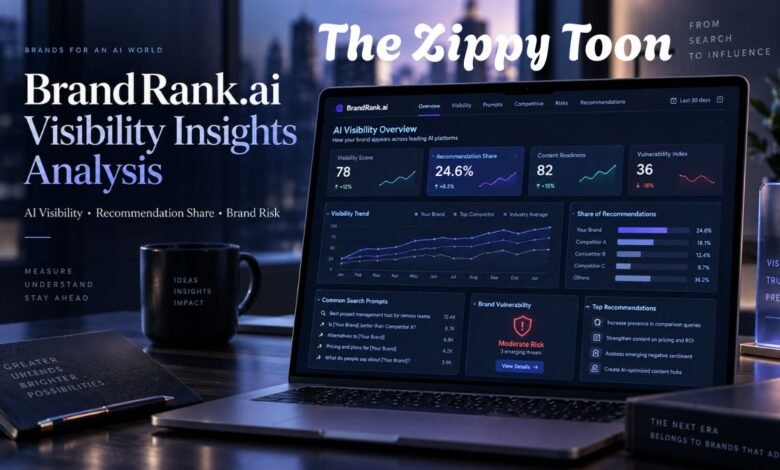
A public BrandRank dashboard example states that its displayed dataset is based on daily searches of 170 phrases across seven answer engines. It shows different scores for individual prompts and models, illustrating how visibility may vary significantly depending on the question and AI provider. Treat this example as a product demonstration, not evidence that every BrandRank customer receives the same 170-prompt configuration.
This approach is strategically useful because purchase intent rarely shows up in a single generic keyword.
Consider the difference between:
- “Best running shoes”
- “Best running shoes for flat feet”
- “Most durable running shoes for heavy runners”
- “Running shoes under $120”
- “Nike vs Brooks for marathon training”
Each prompt creates a different competitive context.
BrandRank’s value proposition is therefore strongest when organizations select prompts tied to real customer decisions rather than simply tracking their company name.
Why One AI Check Is Not Enough
AI responses are not perfectly deterministic.
A 2026 working paper examining 4,497 answers across 90 B2B software products found substantial uncertainty in ordered brand rankings. In six of nine categories studied, the product ranked first could not be statistically distinguished from the product ranked second at the study’s stated confidence level.
Another 2026 working paper studied prompt wording across multiple answer engines and concluded that visibility measurement can change when essentially the same commercial intent is phrased differently.
These findings strengthen the case for repeated, multi-prompt monitoring. They also create an important caution: a dashboard score should not be interpreted as an immutable measure of brand strength.
Prompt selection, model version, location, personalization, retrieval configuration, timing, and response randomness can all affect observed answers.
Recommendation Share™ Is the Metric BrandRank Wants Executives to Watch
BrandRank increasingly differentiates itself from conventional AI-visibility tools through Recommendation Share™.
The company’s stated argument is straightforward: knowing that a brand appeared somewhere in an AI response is less valuable than knowing whether the assistant actually recommended that brand when a consumer was making a decision.
That reframes the measurement from:
“Did AI mention us?”
to:
“Did AI select us when the recommendation mattered?”
BrandRank describes a recurring improvement cycle built around strategically important questions, stronger proof for brand claims, content-gap correction, third-party authority, publication, verification, and repeated measurement.
This is conceptually stronger than tracking raw mentions alone.
It is not, however, the same as real-world market share.
Recommendation Share measures outcomes within a defined set of prompts and engines. It does not directly prove that the same percentage of customers purchased the product, preferred the brand, or even saw those exact responses.
That distinction should remain visible in executive reporting.
A 4.3 Million-Recommendation Study Shows Why Engine-Level Analysis Matters
BrandRank published one of its more substantial datasets on September 1, 2026.
The company said it analyzed 4.3 million AI recommendations across ChatGPT, Claude, Gemini, Grok, and Perplexity between January and July 2026, focusing on private-label and national-brand recommendations.
BrandRank reported that private-label, retailer-owned, and generic options gained 2.7 percentage points of Recommendation Share during the period. It also reported major differences between models: Perplexity showed the largest private-label increase in the dataset, while Claude showed a smaller shift.
The bigger insight is not simply that store brands gained visibility.
It is that different AI engines may produce materially different competitive outcomes.
A marketing team looking only at ChatGPT could miss weaknesses—or strengths—in Gemini, Perplexity, Claude, or another system.
Independent 2026 research has reached a broadly compatible conclusion. An arXiv study analyzing more than 100,000 prompt responses across more than 100 brands found measurable differences in AI visibility by brand maturity and platform, and instability in sentiment-related signals.
Brand Risk Monitor Adds a Reputation Layer That Basic Visibility Scores Miss
Visibility becomes dangerous when an AI answer is visible and wrong.
BrandRank launched its expanded Brand Risk Monitor on August 25, 2026. According to the company, the system traces unfavorable AI responses to underlying material, including government sources, regulatory records, news coverage, independent publications, reviews, legal information, and other sources that can shape AI-generated claims.
BrandRank says findings are dated and assigned severity levels, with the system designed to answer three operational questions:
- What did the monitoring system find?
- Why does it matter?
- What should the organization do next?
This moves the product closer to reputation intelligence rather than pure AEO tracking.
Imagine an AI assistant repeatedly associating Product A with a safety problem that actually involved Product B. Traditional rank tracking would not necessarily detect the issue. Mention tracking might even count the appearance as positive visibility.
A vulnerability system separates visibility from accurate representation.
For regulated sectors, consumer products, healthcare organizations, financial institutions, and large enterprises, that distinction can matter far more than a simple visibility percentage.
Content Readiness Connects Measurement With What Brands Can Actually Fix
An AI-visibility platform is of limited value if it only reports problems.
BrandRank’s Content Readiness framework attempts to identify whether the underlying brand content provides search engines with enough structured and corroborated evidence to understand a company correctly.
Its current public dashboard describes readiness using concepts including content liquidity, search capital, and algorithmic anchors. The company also emphasizes FAQs, structured information, authoritative evidence, third-party corroboration, and accessible brand claims.
This direction aligns with broader GEO research.
The KDD 2024 GEO study demonstrated that presentation and content characteristics can influence visibility inside generative responses, although the effectiveness of individual techniques varied across subject areas.
BrandRank extended its ability to act on such findings when it announced the acquisition of core technology and selected assets from Averi.ai on July 15, 2026. The company said the technology would help customers move from identifying content gaps to creating AI-oriented FAQs, educational pages, product content, and comparison material.
BrandRank.AI’s 2026 Expansion in Context
Date Development Why It Matters
July 15, 2026 BrandRank announced acquisition of core Averi.ai assets and technology Expanded the platform from diagnosis toward AI-assisted content creation.
July 28, 2026 BrandRank announced an initial $3 million seed financing close Added capital for enterprise growth and product expansion.
August 25, 2026 Brand Risk Monitor expansion announced Added deeper source-level analysis of unfavorable AI answers.
September 1, 2026 Private-label recommendation study published Demonstrated large-scale cross-engine Recommendation Share research.
The financing announcement identified Pete Blackshaw as co-founder and CEO and Hank Hudepohl as co-founder and senior operating/product leadership. BrandRank said the funding built on roughly two years of platform development.
Where BrandRank.AI Looks Strong—and Where Analysts Should Stay Careful
BrandRank.AI’s strongest conceptual advantage is that it does not treat all AI mentions as equal.
The combination of recommendation tracking, risk analysis, content diagnostics, source investigation, competitive benchmarking, and human strategist review creates a wider view of AI brand performance than a simple mention counter. The platform also publicly emphasizes recurring measurement rather than one-off screenshots.
Buyers should still consider important limitations.
First, the detailed statistical methodology behind proprietary scores is not fully disclosed in the public material reviewed for this analysis. Organizations evaluating the platform should ask how prompts are sampled, how often identical prompts are rerun, how model changes are normalized, and whether uncertainty intervals accompany comparative rankings.
Second, prompt choice can shape the result. A visibility score based on irrelevant prompts can be technically accurate but strategically useless.
Third, the public G2 listing reviewed does not publish pricing. G2 describes BrandRank.AI pricing as quote-based and directs prospective buyers to contact the vendor.
Finally, several performance improvements highlighted on BrandRank’s website are vendor-reported customer outcomes. They are useful indicators but should not automatically be treated as independently audited performance benchmarks.
What a Serious BrandRank.ai Visibility Insights Analysis Should Actually Examine
A meaningful audit should go deeper than asking for one headline score.
The most useful evaluation would connect five layers:
Prompt coverage → engine visibility → recommendation strength → source evidence → corrective action.
That means marketing teams should examine where they appear, communications teams should inspect claims and reputation risk, SEO/content teams should investigate missing pages and citations, legal teams should review high-risk misinformation, and executives should monitor material changes in recommendation strength.
This cross-functional character may be BrandRank’s most significant strategic idea.
AI-generated brand perception is unlikely to remain exclusively an SEO responsibility because an answer engine can synthesize product information, customer reviews, company statements, regulatory records, journalism, competitor pages, support content, and third-party commentary into a single response.
The Real Metric Is Whether AI Can Defend the Brand It Recommends
BrandRank.ai Visibility Insights Analysis reflects a broader change in digital discovery: brands increasingly need to understand not only where their pages rank, but how machines interpret the evidence surrounding them.
That makes AI visibility measurable—but not simple.
The strongest use of BrandRank is unlikely to be chasing a single dashboard number. It is using repeated prompt data to identify where a company disappears, where its claims lack evidence, where competitors own stronger source signals, and where an AI-generated answer creates a reputation or revenue risk.
Recommendation Share™, vulnerability monitoring, and content readiness are therefore best viewed as connected diagnostics rather than isolated scores.
For organizations entering the AI-answer era, the strategic question has changed.
It is no longer “Can customers find our website?”
It is increasingly “When an AI system makes the choice easier for the customer, does the evidence point to us?”
FAQs.
What is BrandRank.ai Visibility Insights Analysis?
BrandRank.ai Visibility Insights Analysis measures how a brand appears across major AI answer engines. BrandRank evaluates visibility, vulnerability, content readiness, and Recommendation Share™, allowing organizations to examine whether they are present, accurately represented, competitively positioned, and recommended for important customer prompts.
Which AI platforms does BrandRank.AI monitor?
BrandRank.AI currently says its platform tracks seven major answer engines: ChatGPT, Google Gemini, Perplexity, Grok, Claude, Meta AI, and DeepSeek. Monitoring is organized around priority prompts so brands can compare how their presence and recommendation strength differ among AI systems.
What is Recommendation Share™ in BrandRank.AI?
Recommendation Share™ is BrandRank’s proprietary measurement of how frequently a brand is recommended relative to competitors across selected buying and category questions. It distinguishes simple brand mentions from situations where an AI system actually presents the brand as a recommended choice.
Is BrandRank.AI different from traditional SEO software?
Yes. Traditional SEO tools primarily monitor search rankings, keywords, traffic, links, and conventional search visibility. BrandRank focuses on synthesized AI answers: whether a brand appears, what claims AI makes, which sources influence those claims, whether competitors receive the recommendation, and whether brand content is prepared for answer engines.
Can BrandRank.AI guarantee that ChatGPT or Gemini will recommend a brand?
No public evidence supports treating AI recommendation placement as guaranteed. Generative systems are variable; their underlying models and retrieval systems change, and results can depend on prompt wording and other conditions. BrandRank can measure and help optimize observed performance, but AI-engine behavior remains externally controlled.
Is an AI visibility score enough to judge brand performance?
No. Visibility shows whether a brand appears, but not necessarily whether the appearance is favorable, accurate, or persuasive. A complete assessment should also examine recommendation strength, vulnerability, source quality, competitive positioning, content readiness, and statistical variability across repeated prompts and engines.
Editorial Disclaimer
This analysis reflects publicly available information reviewed through September 23, 2026. BrandRank.AI’s proprietary scores, Recommendation Share™ methodology, case-study improvements, and company research should be distinguished from independently audited metrics. AI answer engines change frequently so that visibility measurements can vary by model version, prompt wording, geography, retrieval behavior, personalization, and testing methodology.