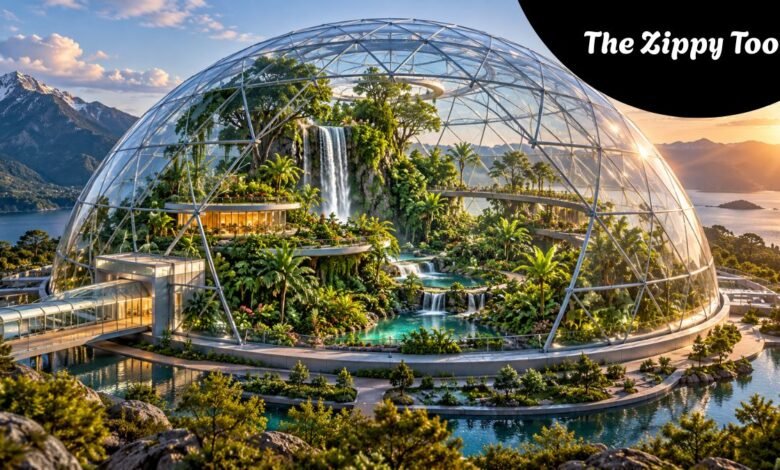
Imagine walking into a large enclosed structure where tropical plants grow, birds move between trees, and different species live in carefully maintained natural surroundings. Outside, the weather might be cold or dry, but inside, the temperature, humidity, and environmental conditions support an entirely different ecosystem. This is the fascinating concept behind a biodome, a structure designed to recreate and maintain ecological environments.
Many people ask what a biodome is, especially when exploring environmental science, sustainable architecture, or modern conservation projects. Although these structures sometimes resemble enormous greenhouses, they serve purposes beyond growing plants. They can provide controlled habitats for animals, microorganisms, and vegetation while helping researchers understand how living organisms interact with their surroundings.
Biodomes demonstrate the delicate relationships between climate, water, soil, plants, and wildlife. They also provide opportunities to study environmental changes and improve conservation practices.
This article explains what biodomes are, how they function, their essential components, famous examples, scientific applications, environmental benefits, and challenges. It also explores how these artificial ecosystems contribute to sustainability, education, and research into the future of human life in controlled environments.
What Is a Biodome?
A biodome is an enclosed or partially enclosed structure designed to support one or more ecosystems under controlled environmental conditions. It combines living organisms with physical elements such as water, soil, light, air, and temperature regulation to create an environment resembling a natural habitat.
Unlike a conventional building, a biodome is designed around ecological relationships. Plants absorb carbon dioxide through photosynthesis, animals consume oxygen through respiration, microorganisms break down organic matter, and nutrients cycle through the environment.
Some biodomes recreate specific natural habitats, including tropical rainforests, temperate forests, wetlands, or coastal ecosystems. Others are developed as experimental facilities where scientists study how ecosystems behave when separated from parts of the outside environment.
However, not every biodome is completely sealed or self-sufficient. Many require fresh air, energy, water treatment, food supplies, and regular human management.
The central idea is to create a functioning, artificially maintained ecosystem that lets natural processes operate within carefully monitored surroundings.
How Does a Biodome Work?
A biodome combines natural biological processes with environmental control systems. These systems help maintain conditions suitable for the plants, animals, and microorganisms living inside.
One of the most important elements is climate regulation. Heating, cooling, ventilation, and humidity-control equipment maintain temperatures and moisture levels appropriate for the intended ecosystem. A tropical habitat, for example, generally requires warmer and more humid conditions than a temperate forest.
Light is another essential requirement. Some biodomes use transparent coverings that let in natural sunlight, while others supplement daylight with artificial lighting. Plants need sufficient light for photosynthesis, which lets them produce sugars from carbon dioxide and water while releasing oxygen.
Water circulates through irrigation systems, soil, plants, and the atmosphere. Evaporation and condensation can drive internal water movement, though many facilities also need additional water supplies and treatment equipment.
Sensors and monitoring systems help staff track environmental changes and adjust conditions when necessary. The result is a carefully managed environment where biological activity continues within a structure designed to support it.
Essential Components of a Biodome
Every biodome depends on several connected components that support ecological stability. The exact design varies by purpose, size, and the habitats it contains.
Plants and vegetation form the foundation of many biodomes. Through photosynthesis, they produce organic matter that supports food webs. They also influence humidity, carbon dioxide levels, soil conditions, and shelter availability for other organisms.
Water systems support hydration, nutrient movement, and biological processes. These may include artificial streams, ponds, irrigation networks, filtration equipment, and drainage systems. In aquatic habitats, maintaining water quality is especially important.
Soil and microorganisms perform functions that are often overlooked. Bacteria, fungi, and other decomposers break down dead organic matter and return nutrients to the environment. Healthy soil communities are therefore essential to sustaining plant growth.
Animals may also be included when appropriate to the recreated habitat. Their presence introduces ecological relationships involving feeding, competition, pollination, and other interactions.
Finally, structural materials and mechanical equipment protect the enclosed environment and allow staff to regulate conditions. Together, these elements create an interconnected ecological system.
What Is the Difference Between a Biodome and a Greenhouse?
Although biodomes and greenhouses may look similar, they serve different primary purposes.
A greenhouse is generally built to grow plants by providing favorable growing conditions. It protects crops and ornamental plants from harsh outdoor weather and lets growers control temperature, ventilation, and irrigation.
By comparison, a biodome often aims to represent or investigate a broader ecosystem. It may contain multiple plant species, animals, microorganisms, soil communities, and aquatic environments that interact through natural processes.
For example, a greenhouse growing tomatoes focuses primarily on supporting healthy plant development and crop production. A biodome recreating a rainforest may instead examine the relationships between vegetation, humidity, soil organisms, and wildlife.
The distinction is not absolute. Some advanced greenhouses support complex biological communities, while certain biodomes are used partly for cultivation. Both structures rely on environmental management, but biodomes typically emphasize ecosystem relationships and ecological understanding.
Famous Biodomes Around the World
Several remarkable projects demonstrate how controlled ecological environments can support education, scientific research, and public awareness.
One notable example is Biosphere 2, located in Arizona, United States. This large research facility contains multiple environments and became internationally known for experiments involving human life inside a substantially closed ecological system. Its early missions showed how difficult it is to balance atmospheric conditions, food production, and ecological processes in a restricted environment.
Another important example is Canada’s Montréal Biodôme. Housed in a former Olympic cycling venue, it recreates several ecosystems of the Americas. Visitors can explore contrasting habitats and observe how plants and animals are adapted to different environmental conditions.
The Eden Project in Cornwall, England, offers another fascinating example of large-scale enclosed ecological environments. Its distinctive biomes contain extensive plant collections, including species from tropical and Mediterranean climates. Although it is not a fully closed ecological system, it demonstrates the educational and conservation value of maintaining different climates within engineered structures.
These projects show that biodome-related facilities can have very different designs and scientific objectives.
Why Are Biodomes Important for Environmental Research?
Biodomes provide researchers with opportunities to examine ecological processes under conditions that can be monitored and, to some extent, controlled.
In natural environments, scientists often struggle to separate the effects of temperature, rainfall, humidity, pollution, and biological interactions. Controlled facilities allow scientists to examine selected environmental factors more closely.
Researchers can study how plants respond to changes in carbon dioxide concentrations, how soil organisms influence nutrient cycling, and how water availability affects ecosystem productivity.
Climate change research is another significant application. Carefully designed experiments can help scientists understand how environmental changes affect plant growth, soil processes, and organism interactions.
Biodomes also support research on ecological resilience, an ecosystem’s ability to withstand disturbances and recover from changing conditions.
However, findings from enclosed ecosystems must be interpreted carefully. A relatively small artificial environment cannot reproduce every aspect of a large natural ecosystem. Biodomes are therefore valuable research tools, not perfect substitutes for studying nature directly.
Can a Biodome Be Completely Self-Sustaining?
One of the most interesting questions about biodomes concerns whether they can survive indefinitely without outside support.
A self-sustaining biodome would need to maintain essential conditions through internal processes, including water recycling, nutrient cycling, atmospheric balance, and sufficient food production where animals or humans are present.
In theory, natural ecosystems provide useful models because matter moves through interconnected biological and chemical cycles. Plants, animals, decomposers, and microorganisms each contribute to these processes.
In practice, creating a fully self-sustaining artificial ecosystem is extremely difficult. Small changes in oxygen or carbon dioxide levels, unexpected population growth, equipment problems, and nutrient imbalances can disrupt the entire system.
Early Biosphere 2 experiments illustrated several of these challenges, including changes in atmospheric oxygen and difficulties with food production.
Most operational biodomes therefore depend on external energy, equipment maintenance, and some level of resource input. Their success lies in supporting controlled ecological activity rather than achieving complete independence from the outside world.
How Biodomes Support Education and Wildlife Conservation
Biodomes can play an important role in helping people understand the natural world. Instead of learning about ecosystems exclusively through books or videos, visitors can observe living environments and their relationships firsthand.
Educational facilities can show how tropical plants adapt to moisture, how aquatic habitats function, and how different species depend on their surroundings.
This experience can make environmental science more accessible to students, families, and researchers. It also highlights why biodiversity matters and how environmental disturbances may affect entire biological communities.
Some biodome facilities support plant conservation, scientific collections, and research on species that require carefully maintained growing conditions.
However, housing organisms within an artificial environment does not automatically guarantee meaningful conservation benefits. Effective conservation requires suitable animal welfare standards, careful species management, scientific planning, and connections to broader efforts to protect natural habitats.
Biodomes are especially valuable when they encourage practical environmental understanding while supporting genuine research and conservation objectives.
What Are the Main Challenges of Building a Biodome?
Constructing and operating a biodome involves substantial technical, financial, and ecological challenges.
One major concern is energy consumption. Maintaining specific temperatures and humidity levels can require significant heating, cooling, and ventilation, particularly when the desired internal climate differs greatly from the surrounding weather.
Water management presents another challenge. Facilities must prevent contamination, maintain appropriate moisture levels, and keep aquatic systems healthy.
Maintaining ecological balance can also be difficult. A pest outbreak, plant disease, or unexpected change in one population may affect other organisms within the enclosed environment.
Construction costs vary considerably depending on building size, materials, environmental systems, and the complexity of the ecosystems involved. Large public biodomes may also require specialist staff, veterinary support, horticultural expertise, and ongoing maintenance.
These challenges explain why biodomes need careful planning and long-term management. Their ecological value depends not only on the structure itself but also on how responsibly and efficiently it operates.
The Future of Biodomes and Sustainable Living
As interest in environmental technology grows, biodomes may offer useful insights into more efficient resource management and sustainable building design.
Researchers can use controlled ecological systems to study water recycling, plant cultivation, environmental monitoring, and ways to reduce resource waste.
These studies may also contribute to space exploration. Future long-duration missions could benefit from biological life-support systems that recycle water, support food production, and help manage atmospheric conditions. Biodome research provides lessons about how challenging these systems can be.
On Earth, biodome-inspired designs may influence educational facilities, indoor agriculture, botanical collections, and buildings that integrate vegetation with environmental controls.
Nevertheless, biodomes are not a replacement for natural forests, wetlands, oceans, or healthy agricultural landscapes. Protecting existing ecosystems remains essential.
Their greatest long-term contribution may be the knowledge they provide about ecological relationships and responsible resource use.
Conclusion
Understanding what a biodome is reveals much more than the purpose of an enclosed ecological building. Biodomes demonstrate how plants, animals, microorganisms, water, soil, and climate interact to create functioning living environments.
These structures offer valuable opportunities for scientific research, conservation education, environmental monitoring, and experiments involving resource recycling. Projects such as Biosphere 2 and the Montréal Biodôme show how different facilities can explore ecological systems through innovative design.
Although maintaining stable artificial ecosystems is challenging, biodomes help researchers investigate the complex relationships that sustain life.
Ultimately, they matter because they improve our understanding of nature and encourage more informed decisions about environmental protection, sustainability, and the future of ecological technology.
(FAQs)
1. What is a biodome in simple words?
A biodome is an enclosed structure that recreates or maintains a natural ecosystem under controlled conditions. It may contain plants, animals, water, soil, and microorganisms that interact within a managed environment.
2. Can humans live inside a biodome?
Yes, humans can live inside suitably designed biodomes for experimental periods. However, long-term habitation requires reliable food, water, oxygen, waste management, and environmental control systems.
3. Is a biodome the same as a greenhouse?
No. A greenhouse is mainly designed for growing plants, while a biodome typically focuses on maintaining or studying a broader ecosystem with multiple interacting biological and environmental components.
4. What is the largest biodome in the world?
The answer depends on how you define and measure a biodome. Large facilities such as Biosphere 2 and the Eden Project are notable examples, but they serve different purposes, so you can’t reliably rank them without specifying the measurement criteria.
5. Why are biodomes important for the future?
Biodomes help scientists study ecosystem relationships, controlled agriculture, resource recycling, and environmental management. Research in these areas may support conservation, sustainable technologies, and future biological life-support systems.