Starting a food business requires much more than developing a delicious product. Entrepreneurs must find reliable ingredients, arrange manufacturing, create attractive packaging, manage inventory, and establish dependable distribution channels. These responsibilities can become overwhelming, particularly for businesses entering the market with limited resources. Foodie Co operates in this demanding environment by providing manufacturing and supply chain support tailored to startups and smaller food brands.
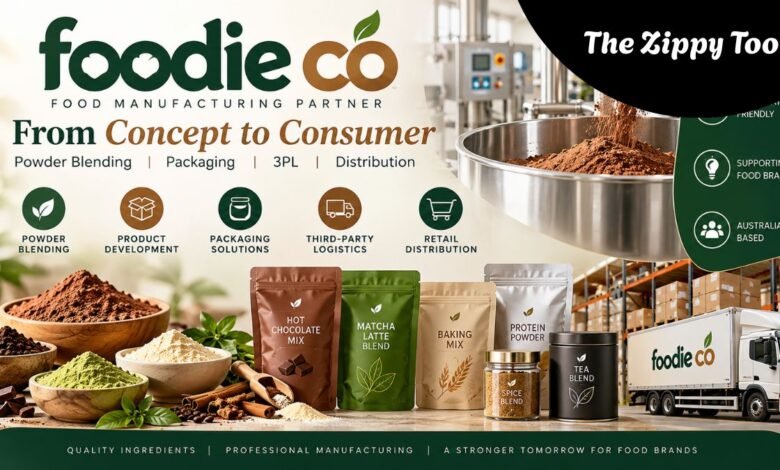
Based in Dingley Village, Victoria, Australia, the company specializes in dry powder blending, packaging, third-party logistics, and food distribution. Its services help businesses move from initial product concepts towards commercial production without necessarily investing in their own manufacturing facilities. Rather than focusing exclusively on large-scale production, the company offers flexible solutions that support different stages of business development.
This article explores Foodie Co’s manufacturing services, packaging capabilities, organic production approach, logistics solutions, and distribution model. It also explains the practical considerations that food entrepreneurs should evaluate before selecting a manufacturing partner.
What Is Foodie Co?
Foodie Co is an Australian food and beverage manufacturing business that provides specialized production and operational services for emerging and established food brands. Its activities include powder blending, product packaging, third-party logistics, and retail distribution. The business primarily operates within the business-to-business market, meaning its services are designed for other companies rather than functioning simply as a conventional restaurant or consumer food retailer.
The organization addresses a common challenge in the packaged food industry: smaller companies often struggle to access manufacturing services because established factories may impose high minimum production quantities. Foodie Co offers a more flexible approach, supporting businesses seeking smaller manufacturing runs as well as those preparing for larger production requirements.
Its operating model lets entrepreneurs focus on brand development, marketing, customer relationships, and product improvement while outsourcing select production and logistics responsibilities. The precise level of support depends on each client’s requirements, production specifications, and commercial arrangements.
Why Foodie Co Is Relevant to Emerging Food Brands
The journey from a homemade recipe to a commercially available product can be surprisingly complicated. A recipe that works in a home kitchen may behave differently at scale. Ingredient consistency, equipment limitations, packaging requirements, and shelf-life considerations can all influence the final result. Entrepreneurs must also consider manufacturing expenses and the financial consequences of producing more stock than customers are ready to purchase.
This is where flexible contract manufacturing becomes valuable. Instead of building a production facility immediately, a smaller business can assess whether an experienced manufacturing partner can deliver the required product at a commercially viable volume. Such arrangements may reduce the need for substantial upfront equipment investments, although outsourcing still involves manufacturing, packaging, storage, and transportation costs.
Foodie Co’s focus on smaller businesses reflects these industry challenges. Its services are structured to support brands that need assistance with commercial production without necessarily committing to the quantities demanded by larger manufacturers.
Foodie Co Powder Blending and Manufacturing Services
One of the company’s central specializations is dry powder blending, a manufacturing process that combines measured quantities of powdered ingredients into a consistent mixture. Although the process may appear straightforward, commercial blending requires attention to ingredient characteristics, mixing procedures, equipment suitability, and quality control. Powders can behave differently depending on particle size, density, moisture sensitivity, and formulation.
According to the company’s published manufacturing information, its product categories include hot chocolate mixes, latte blends, tea blends, baking mixes, spices, and selected nutrition and supplement powders. These products require different formulations and packaging approaches, making production planning essential to the manufacturing process.
For example, a drinking chocolate mixture should maintain consistent flavor and appearance across batches, while a baking mix must distribute ingredients appropriately to help customers achieve predictable results. Product consistency matters because buyers expect the same experience whenever they purchase a familiar item.
Foodie Co’s powder manufacturing services are intended to help businesses manage these commercial production requirements through an outsourced manufacturing arrangement.
Product Development From Concept to Commercial Production
Successful food products often begin with a simple observation about customer needs. An entrepreneur might notice interest in a specialized beverage mix, a convenient baking product, or a distinctive spice blend. Turning that concept into a marketable product, however, requires decisions concerning ingredients, formulation, production quantities, packaging, and costs.
Foodie Co describes its manufacturing process through four broad stages: create, produce, third-party logistics, and distribution. This structure reflects the different activities involved in bringing packaged food products into the market. Importantly, clients are not necessarily required to purchase every available service. The company indicates that businesses can discuss individual solutions, including formulation assistance, blending, and packaging for existing products.
Before entering production, businesses should establish clear product specifications. These may include intended serving sizes, ingredient requirements, target retail pricing, expected production volumes, and packaging preferences. Testing and reviewing these details before manufacturing can help identify potential problems and support more informed commercial decisions.
Professional Packaging and Product Presentation
Packaging plays a major role in determining how food products are protected, stored, transported, and presented to customers. An attractive design can help a product stand out, but its practical function is equally important. Suitable packaging must account for the food’s characteristics, potential moisture exposure, handling conditions, and relevant labeling requirements.
Foodie Co identifies composite tins, heat-sealed pouches, and bags as packaging formats for discussion. Different products may benefit from different solutions. Powdered beverages, for instance, may be packaged in resealable containers depending on their intended use, while larger food-service quantities may require formats designed for commercial handling.
For smaller food businesses, packaging decisions also affect manufacturing budgets and transportation expenses. Premium containers may support particular branding strategies but can increase production costs. Businesses must therefore balance appearance, functionality, affordability, and customer expectations.
Professional packaging should do more than make a product visually appealing. It should protect the product, communicate clearly, and provide a convenient consumer experience.
The Importance of Organic Manufacturing
Growing consumer interest in ingredient sourcing and production standards has led many businesses to explore organic manufacturing options. Foodie Co describes itself as a certified organic manufacturer, making this aspect of its services relevant to businesses developing products intended for the organic food market.
Organic production involves more than choosing ingredients described as natural. Certified organic claims generally require compliance with the applicable certification scheme, including requirements concerning ingredient sourcing, handling, processing, and documentation. The exact rules vary by certification standard and market.
A manufacturer that works with organic products may be a good fit for businesses seeking suitable processing arrangements. However, companies should verify the manufacturer’s current certification, its scope, and whether their proposed products and ingredients meet the relevant requirements.
It is also essential to distinguish between a certified production facility and an individual finished product. Organic certification claims should only be made when supported by the necessary evidence and applicable approval.
Third-Party Logistics and Inventory Management
Manufacturing is only one stage of operating a successful packaged food business. Once products are ready for sale, companies need appropriate storage, inventory management, order processing, and shipping coordination. These responsibilities can take considerable time, especially when a small team manages both daily operations and business growth.
Third-party logistics, commonly abbreviated as 3PL, refers to outsourcing certain logistics responsibilities to an external service provider. Foodie Co advertises services that cover storage, business-to-consumer and business-to-business orders, and freight.
For a growing food brand, this arrangement may simplify operations by reducing the need to coordinate independently with multiple warehousing and fulfillment providers. It can also let business owners focus more on customer acquisition, product development, and retailer relationships.
Nevertheless, logistics performance depends on contractual terms, warehouse procedures, shipping arrangements, and service capacity. Businesses should carefully review these factors before committing to an ongoing fulfillment partnership.
Foodie Co Retail Distribution and Market Access
Developing an attractive food product does not automatically guarantee retail sales. Brands must identify suitable outlets, explain their products’ commercial appeal, establish wholesale pricing, and maintain reliable supply arrangements. Retail distribution therefore represents an important step beyond manufacturing.
Foodie Co describes its distribution activities as serving health-food retailers, independent supermarkets, studios, cafés, and food-service businesses. This positioning may interest brands targeting specialized retail environments rather than relying exclusively on supermarket chains.
Distribution support can provide an additional route for introducing products to potential commercial customers. However, securing a distribution arrangement does not guarantee that every retailer will stock a product or that specific sales volumes will be achieved.
Manufacturers and distributors can support market access, but long-term performance still depends on factors such as customer demand, product quality, competitive pricing, appropriate marketing, and consistent availability.
Understanding Manufacturing Costs and Minimum Order Quantities
One of the most important financial considerations for a food startup is the minimum order quantity (MOQ). This is the smallest production order a manufacturer will accept. High minimum quantities can create difficulties for businesses without established sales because large initial orders tie up money in inventory.
Foodie Co identifies minimum manufacturing volumes as a key reason for its startup-oriented approach. The company offers production services ranging from small batches to larger requirements, though specific minimum quantities and prices depend on the proposed project.
Businesses comparing manufacturing partners should look beyond the quoted production cost. Ingredient expenses, packaging materials, formulation work, testing, transport, storage, and fulfillment fees can all influence the final cost per unit.
A financially sustainable product must leave sufficient margin after accounting for manufacturing expenses, distribution costs, retailer requirements, and other business overheads. Careful budgeting before production is therefore essential.
Quality Control and Food Safety Considerations
Reliable food manufacturing requires consistent procedures and appropriate attention to safety. Businesses must consider ingredient traceability, allergen management, hygienic handling, labeling accuracy, shelf-life evaluation, and product specifications. These considerations are especially important when manufacturing products that reach customers through multiple distribution channels.
Food brands operating in Australia must also understand the applicable food standards and regulatory responsibilities associated with their products. Requirements vary by ingredients, product classification, intended claims, and distribution markets.
Although Foodie Co publicly describes its manufacturing capabilities, prospective clients should independently confirm the quality assurance procedures relevant to their proposed products. Useful questions include how ingredients are tracked, how batch consistency is assessed, what allergen controls apply, and which party is responsible for required testing.
Food safety and consumer trust should remain central priorities for any company entering the packaged food market.
How to Decide Whether Foodie Co Is the Right Manufacturing Partner
Choosing a manufacturer is a business decision that deserves careful investigation. What works for one brand may not meet another brand’s needs. Product complexity, order quantities, required certifications, packaging specifications, delivery schedules, and overall costs can all influence compatibility.
Foodie Co may be worth evaluating for Australian businesses developing powdered food or beverage products, particularly those seeking outsourced manufacturing alongside packaging or distribution support. Its advertised focus on emerging brands provides a starting point for conversations about smaller production requirements.
Before proceeding, entrepreneurs should request details on minimum order quantities, quotes, production schedules, ingredient responsibilities, packaging options, confidentiality, and formulation ownership. Written agreements should explain which services are included and how potential manufacturing issues will be addressed.
Comparing several suitable providers can help a business determine whether the proposed arrangement offers the right combination of quality, flexibility, reliability, and commercial value.
The Future of Flexible Food Manufacturing
The food industry includes businesses of vastly different sizes, from entrepreneurs testing new recipes to established companies managing national distribution networks. These organizations have different manufacturing needs, creating opportunities for specialized service providers.
Flexible outsourcing models let brands access professional production and logistics support without owning every part of their supply chain. This approach can be attractive when demand is uncertain or when companies want to focus resources on product innovation and customer relationships.
Foodie Co operates in this segment by combining several related services. Its long-term development will depend on factors including operational performance, customer relationships, manufacturing demand, and its ability to meet changing industry requirements.
No publicly available information guarantees the company’s future growth. Nevertheless, its business model illustrates how specialized manufacturing and logistics providers can address practical challenges faced by smaller food enterprises.
Conclusion
Foodie Co represents an Australian business model that makes food manufacturing and distribution services accessible to startups and smaller brands. Through dry powder blending, packaging options, third-party logistics, and retail distribution support, the company offers services that address several important stages of the packaged food supply chain.
Its emphasis on flexible production may be particularly relevant to entrepreneurs who struggle to meet the large minimum orders common in industrial manufacturing. Its advertised organic manufacturing capability also provides an additional consideration for businesses developing suitable products.
For entrepreneurs exploring manufacturing partnerships, the central priority should be finding a provider that meets their product requirements, quality expectations, production volumes, and financial circumstances. With careful planning and clear commercial agreements, outsourced manufacturing can become a practical part of building a sustainable food brand.
(FAQs)
1. What is Foodie Co known for?
Foodie Co is known for providing powder blending, food manufacturing, packaging, third-party logistics, and distribution services. Its business model focuses on startups and smaller food brands that need flexible commercial production support.
2. Where is Foodie Co located?
The company is based in Dingley Village, Victoria, Australia, in Melbourne’s metropolitan area. It provides manufacturing and distribution-related services for food and beverage businesses.
3. What types of products can Foodie Co manufacture?
Its advertised product categories include hot chocolate mixes, latte blends, tea blends, baking mixes, spices, and selected nutrition and supplement powders. Discuss individual manufacturing requirements directly with the company.
4. Does Foodie Co provide organic manufacturing services?
Yes. The company describes itself as a certified organic manufacturer. Businesses should confirm current certification details and product-specific requirements before making organic claims about finished products.
5. Can small food businesses use Foodie Co’s services?
Yes. Foodie Co specifically promotes its services to startups and small businesses. Its flexible manufacturing approach is intended to address challenges associated with large production quantities, although exact order requirements and costs need individual confirmation.