Intelligent Putty: The Strange Polymer That Stretches, Bounces, Tears, and Slowly Flows
It can behave like a soft liquid one moment and an elastic solid the next—yet there is no artificial intelligence hiding inside the tin.

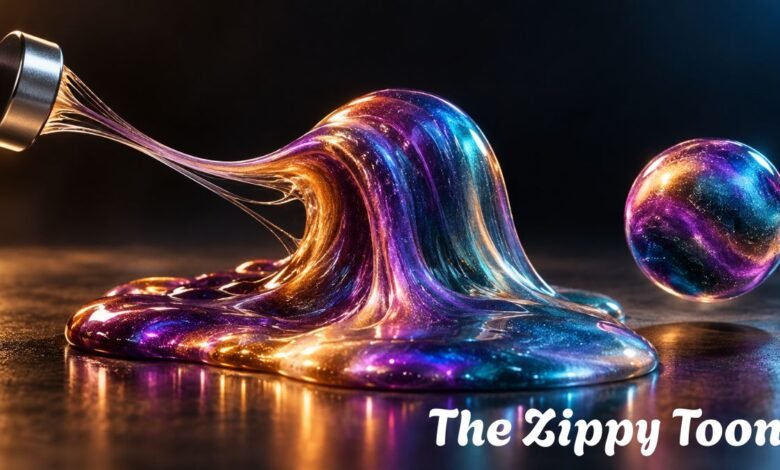
Intelligent Putty looks simple until you start testing it. Pull it gently, and it can stretch into a long strand. Roll it into a ball and certain formulations bounce. Tug it suddenly, and the material may tear instead of stretching. Leave a piece sitting for long enough, and gravity can slowly flatten it.
Those contradictory behaviors are exactly why intelligent Putty remains interesting beyond ordinary modeling clay. The material sits at the intersection of sensory play, polymer chemistry and rheology—the science of how materials deform and flow.
The phrase also needs clarification. “Intelligent putty” is not one universally standardized chemical product or an AI-powered material. Retailers in parts of Europe use names such as Intelligente Knete or intelligent Putty for unusual viscoelastic toy putties, while Crazy Aaron’s markets a major U.S. family of related products under the Thinking Putty® name.
Intelligent Putty is a moldable viscoelastic polymer material whose response changes according to how force is applied. Slow deformation allows many putties to stretch or creep, while rapid deformation can make them bounce, tear, or resist movement. Commercial formulas vary, so check each product’s properties, ingredients, effects, and safety instructions.
Why Intelligent Putty Seems to Break the Rules of Ordinary Materials
A block of wood is recognizably solid. Water is recognizably liquid. Intelligent Putty refuses to fit comfortably into either everyday category.
Its unusual behavior is associated with viscoelasticity. A viscoelastic material displays characteristics associated with both viscous fluids and elastic solids. Rheology research shows that polymers can respond very differently depending on the rate and type of stress applied. The American Chemical Society specifically uses Silly Putty-like materials when discussing unusual polymer behavior under different stress conditions.
That explains the experience users notice immediately.
Pull a compatible putty slowly, and its polymer structure has more time to rearrange, allowing the material to extend. Apply force rapidly, and those molecular rearrangements cannot occur in the same way. The material can consequently feel much firmer or fracture rather than forming a long strand.
Some putties can also be rolled into a ball and bounced because short-duration impact produces a more elastic response than the slow gravitational stress experienced when the same material is left sitting on a surface.
The slow-flow experiment reveals what your hands miss.
Place a mound of intelligent Putty on a clean surface and leave it undisturbed. Depending on its formulation, it may gradually spread.
This behavior matters because it shows that the material’s apparently solid shape isn’t necessarily permanent.
American Chemical Society educational material describes the closely related behavior of Silly Putty: when left on a table, it can slowly flow and flatten.
The effect is not magic. Material science is at work on a longer timescale than the quick stretching, bouncing, and tearing people normally notice.
Inside the Material: Silicone, Polymer Chains and Closely Guarded Formulas
You shouldn’t assume the same ingredients apply to every product sold as intelligent Putty.
Crazy Aaron’s, for example, describes its current magnetic Thinking Putty products as made from non-toxic silicone, while the company states its specialized formulas are proprietary.
Silicone chemistry is strongly associated with classic putty materials. The American Chemical Society identifies polydimethylsiloxane (PDMS), also called dimethicone, as a flexible silicon-oxygen-backbone polymer and lists Silly Putty among its applications.
That does not mean every intelligent putty tin contains the same mixture or that every formula can be reduced to one ingredient. Pigments, fillers, magnetic materials, fluorescent compounds, fragrances, and other components can dramatically change appearance and performance.
Polymer structure explains more than the marketing name.
The word “intelligent” can make the product sound electronically sophisticated. In reality, the interesting behavior comes primarily from the material’s physical chemistry.
Long polymer chains interact differently from ordinary small molecules. Depending on molecular structure, cross-linking and formulation, a polymer system may store some deformation energy like an elastic object while simultaneously dissipating or redistributing stress through flow.
This is why the same handful of Putty can produce several apparently conflicting results without containing sensors, processors, or software.
From Basic Putty to Magnetic, UV and Color-Changing Versions
Modern sensory Putty is no longer limited to a single texture or color.
Crazy Aaron’s current product range includes categories such as Magnetic Storms, Glow in the Dark, Color Change, Liquid Glass, SCENTsory and Hide Inside products. The company says it has produced Thinking Putty since 1998 and uses different proprietary formulas to produce these effects.
Magnetic Putty is especially striking because the visual movement makes the material appear almost alive.
A current Crazy Aaron’s magnetic product, Strange Attractor, comes with a ceramic magnet and is described as a silicone-based putty that can stretch, bounce, tear, sculpt, and interact magnetically.
The magnet does not make the polymer itself “smart.” Instead, the formulation incorporates magnetically responsive material so an external magnetic field can exert force on it.
Color effects add another layer of responsive play.
Some intelligent putties use temperature-sensitive, ultraviolet-responsive, glow-in-the-dark, or interference pigments.
These effects may seem sophisticated because the putty changes as its environment changes, but the response still comes from physical or chemical material properties rather than digital intelligence.
That distinction matters for accurate product descriptions: responsive material does not automatically mean electronically intelligent material.
Why Intelligent Putty Became More Than a Children’s Toy
One reason these materials endure is their tactile experience.
Commercial manufacturers position Putty for stretching, squeezing, molding, and sensory interaction. Crazy Aaron’s states that Thinking Putty provides tactile play and can exercise hand and finger movement. However, such manufacturer statements should not be treated as proof of medical or therapeutic effectiveness.
Putty also provides a convenient demonstration of material science.
Students can observe time-dependent deformation without complicated laboratory equipment. One sample can demonstrate elasticity, slow flow, deformation, fracture, and—depending on the formulation—magnetic or optical behavior.
Related putty-like polymers have even appeared in scientific research. A 2019 ACS Nano paper used a viscoelastic polymer identified as Silly Putty in a shape-adaptive, self-healing triboelectric nanogenerator system, showing that the unusual mechanics associated with putty-like polymers can be useful far beyond novelty toys.
Intelligent putty is most interesting when treated as a hands-on demonstration of polymer physics rather than as a mysterious “smart” substance.
Choosing Intelligent Putty Without Falling for Vague Claims
The first question should be what kind of experience you want.
A standard putty may be suitable for stretching, sculpting, and bouncing. A magnetic version introduces magnet interaction. Glow and color-change products focus more heavily on visual effects. Clear versions emphasize optical appearance, while miniature containers prioritize portability.
Current Crazy Aaron’s pricing also illustrates how widely formats can differ: its U.S. site lists some mini tins at around $4, Trendsetters products around $12, and several full-size or specialty products around $15 at the time of verification in September 2026. Prices and availability can change.
Consumers should compare actual product specifications rather than assuming every item called intelligent Putty has the same weight, formula, or performance.
The label matters more than the nickname.
Look for:
- Recommended minimum age
- Product weight
- Manufacturer or importer
- Safety warnings
- Material information when provided
- Magnetic components
- Storage instructions
- Applicable conformity or toy-safety information
A descriptive phrase such as “intelligent,” “smart,” “thinking,” or “magic” should never replace those concrete details.
The Safety Detail That Matters Most With Magnetic Putty
Ordinary sensory Putty and magnetic Putty should not automatically be treated as identical products.
Crazy Aaron’s says its Thinking Putty is non-toxic and reports extensive product-safety testing. The company also states that standard Thinking Putty is not intended for children under three because of choking concerns, while some magnetic products are recommended for ages eight and above.
Magnetic sets require particular attention.
Current Crazy Aaron’s magnetic products include a warning that swallowed magnets can attract one another across intestinal tissue, creating a serious medical emergency.
That warning concerns the supplied magnet and does not mean every magnetic-putty product has identical risks or components. Users should follow the instructions supplied with the specific product they own.
FAQs.
What is intelligent Putty?
Intelligent Putty is a viscoelastic moldable polymer toy designed to behave differently under different kinds of force. Depending on its formulation, it can stretch, bounce, tear, sculpt, and slowly flow. The term is used commercially and does not indicate artificial intelligence or embedded computer technology.
Why does intelligent putty stretch slowly but tear when pulled quickly?
Intelligent Putty changes behavior because its polymer network responds to the rate of deformation. During slow pulling, molecular structures have more time to rearrange. A sudden force gives them far less time, so the material resists deformation or fractures rather than forming a long, continuous strand.
Is intelligent Putty the same as Thinking Putty?
Intelligent Putty is a broader retail description, while Thinking Putty® is a branded product name associated with Crazy Aaron’s. European retailers also use terms such as Intelligente Knete. Products can share similar viscoelastic behavior without necessarily having identical manufacturers, formulas, effects, or safety specifications.
Does intelligent Putty contain artificial intelligence?
Intelligent Putty does not ordinarily contain artificial intelligence. Its seemingly “smart” responses come from polymer physics and, in specialty versions, additives such as magnetic or optical materials. It reacts to force, temperature, ultraviolet light, or magnets because of material properties, not algorithms or electronic processors.
Does intelligent Putty dry out?
Some silicone-based commercial putties are specifically designed not to dry out under normal use. Crazy Aaron’s states that Thinking Putty does not dry out, while European intelligent-putty sellers make similar claims for certain products. Users should still keep the material clean and follow the manufacturer’s storage directions.
Is intelligent Putty safe for children?
Intelligent putty safety depends on the exact product, age, and included accessories. Crazy Aaron’s states that its Thinking Putty is non-toxic but warns against use by children under three, and some magnetic versions carry higher minimum-age recommendations and serious magnet-ingestion warnings. Always follow the label for the specific product.
The Real Intelligence Is in the Material
Intelligent Putty earns attention because a small piece of polymer can make abstract material science visible.
Stretch it slowly and time becomes part of the experiment. Bounce it, and elasticity becomes obvious. Leave it alone and viscous flow appears. Add magnetically responsive or optical components and an apparently simple toy becomes a practical demonstration of how formulation changes material behavior.
Calling it “intelligent” is clever marketing. Understanding why it behaves intelligently is considerably more interesting.
Its unusual response is not evidence of hidden electronics or artificial intelligence. It is an accessible example of polymer chemistry, viscoelasticity, deformation rate and material design—concepts that also matter in manufacturing, soft materials and advanced engineering research.
Editorial Disclaimer
Product formulas, prices, availability, recommended ages and safety instructions can change and may differ between manufacturers and countries. “Intelligent putty” is not a single standardized formulation. Scientific explanations in this article describe established behavior of viscoelastic and putty-like polymer systems; they should not be interpreted as disclosure of any manufacturer’s proprietary recipe or as medical advice.