RLP Letter Explained: Why This UK Civil-Recovery Demand Looks Serious—and What It Actually Means
An RLP Letter may ask for payment after a retail incident, but it is not the same as a police fine, a criminal conviction, or a County Court judgment.

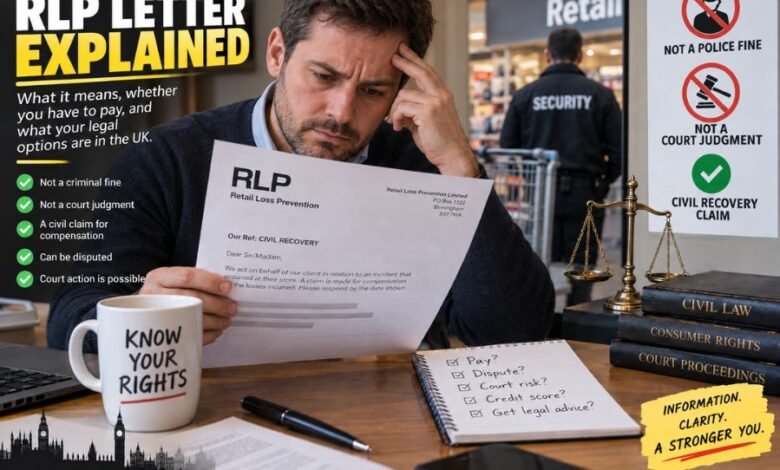
Receiving an RLP Letter can feel unsettling. It might come after an alleged shoplifting, fraud, or other retail incident, include a demand for money, list losses claimed by a retailer, and warn that more action could follow. If you are not familiar with civil recovery, the letter’s wording can make it seem like the matter is already decided before you even understand what is being claimed.
The key point is that RLP, or Retail Loss Prevention Limited, is a private company that handles civil-recovery claims. According to Companies House, Retail Loss Prevention Limited (company number 04802733) is an active private limited company registered on 18 June 2003.
This means you should take an RLP Letter seriously and read it carefully. A demand for compensation does not mean there is already a judgment saying you owe the amount requested.
Bottom line: An RLP Letter is correspondence concerning a retailer’s civil claim for compensation, usually administered by Retail Loss Prevention Limited. It is not itself a police fine, a criminal conviction, or a court judgment. Whether the retailer can establish liability and recover the amount claimed depends on the facts, evidence and applicable civil law.
What Is Actually Behind an RLP Letter?
Retail Loss Prevention says businesses refer incidents to it and provide information about what allegedly happened. RLP then acts as an agent in administering the civil-recovery process.
According to RLP’s current explanation of its procedure, its first correspondence normally identifies when and where the incident allegedly occurred, the business involved, how the claimed civil liability arose, the amount sought and options for dealing with the matter.
The allegations can extend beyond straightforward shoplifting. RLP publicly describes its work as covering matters including alleged theft, refund or discount fraud, price-swapping, collusion, malicious damage, and other business losses.
The monetary demand may exceed the retail value of goods.
RLP says claimed losses can potentially include:
- goods that were not recovered or could not be resold;
- employee or management time;
- administrative activity;
- security-related expenditure; and
- disruption associated with the incident.
However, just listing a type of loss in a letter does not automatically prove that every amount in that category can be legally recovered in a specific case. This difference became especially important in a well-known County Court decision about retail civil recovery.
Criminal Proceedings and an RLP Claim Are Two Different Tracks
One of the biggest sources of confusion is the assumption that police involvement determines whether an RLP claim can exist.
It does not necessarily do so.
RLP states that civil and criminal proceedings are separate and that a retailer may pursue a civil claim whether or not police attended. Its published guidance also distinguishes the standards involved: criminal guilt is determined under the criminal standard of proof, while civil liability is generally determined on the balance of probabilities.
The 2012 Oxford Case Is Why the Amount Claimed Deserves Careful Scrutiny
A frequently cited case in this area is A Retailer v Ms B and Ms K, decided by His Honor Judge Charles Harris QC at Oxford County Court on 9 May 2012.
The facts were significant. The two defendants admitted taking goods from a Milton Keynes store, but the items were recovered undamaged. The retailer sought £137.50, comprising £82.50 for staff or management time, £24.75 for administration costs, and £30.50 for security and surveillance.
The retailer did not succeed.
The court examined whether the defendants had actually caused the claimed expenditure. The security employees had been hired specifically to perform tasks that included surveillance, patrolling, apprehending suspected shoplifters and processing incidents.
Judge Harris found that the security personnel had essentially been doing the work they were already employed to perform. The retailer had not established significant staff diversion or significant disruption to its business. The security equipment had also already been installed and paid for.
The judgment consequently dismissed the claims for staff time, administration and security costs in those particular circumstances.
This does not mean that all retail civil-recovery claims are invalid.
The judgment expressly recognized circumstances where genuine losses could potentially be recoverable—for example, lost or damaged goods, directly attributable expenses, physical damage, injuries or staff being genuinely diverted from their normal revenue-producing duties.
The main takeaway is that whether a wrongful act happened and how much can be recovered are two separate issues.
Before Paying or Disputing, Examine What the Retailer Is Actually Claiming
A recipient should first distinguish allegations from facts.
Read the complete correspondence and identify:
- The retailer involved.
- The date and location of the alleged incident.
- What conduct is alleged.
- Whether goods were recovered.
- Whether they were damaged or unsaleable.
- The exact amount demanded.
- How that amount is broken down.
- Any response deadline.
- Whether the document is ordinary correspondence, a formal pre-action letter or actual court paperwork.
- What evidence exists that supports or contradicts the allegation.
This is important because the Civil Procedure Rules expect both sides to share enough information to understand each other’s positions and try to settle disputes before going to court. If there is no specific pre-action protocol, the claimant usually gives the basis for the claim, a summary of the facts, what they want, and, for money claims, how the amount was calculated.
If you want to dispute a claim, you should explain what you disagree with and why, instead of just saying you deny it.
RLP also tells people who deny wrongdoing to explain what happened and give reasons for their defense.
Ignoring an Ordinary Letter and Ignoring Court Papers Are Not the Same Thing
Online discussions about RLP often boil the issue down to just two options: either “pay immediately” or “ignore everything.”
Neither of these is a good rule for every situation.
The right response depends on your specific situation.
If you dispute the allegation, evidence is very important. Keep receipts, bank records, witness details, correspondence, and a clear timeline.
If you accept responsibility but question the amount, you should still check the legal basis and how the losses were calculated.
If you are unsure about your legal position, RLP’s website suggests getting advice from a solicitor or another qualified adviser.
Most importantly, real court documents should never be treated like just another collection letter. Once legal proceedings start, there are formal deadlines and rules you must follow.
It is also important to be clear about the financial consequences. An RLP demand alone is not a County Court judgment. Suppose a court case leads to a CCJ, GOV.UK says the judgment usually stays on the Register of Judgments, Orders and Fines for six years. If you pay it in full within one month, it can usually be removed from the register.
This difference is more helpful for understanding than just saying that an RLP Letter “affects your credit.”
The Most Important Distinction Is Between a Demand and Proven Damages
An RLP Letter can address a real legal dispute, so it is unwise to ignore it simply because it comes from a private company. But it is also wrong to treat everything in the letter as if a judge has already decided you are liable.
Retail civil recovery turns on evidence.
Was there conduct that can be legally challenged? What loss did the retailer really have? Were the goods recovered? Were they damaged? Was staff time truly diverted? Is there support for the amount claimed? Has anyone admitted liability? Are there any documents that disagree with the retailer’s version of events?
The Oxford County Court decision shows why these questions are important. Even when shoplifting was admitted, the retailer still had to prove the specific damages it claimed, and in that case, it failed.
If you have an RLP Letter, the most important thing to remember is to look at the allegation, the evidence, and the claimed losses as separate issues.
FAQs.
Do I have to pay an RLP Letter immediately?
An RLP Letter is a civil demand, not a court order. Getting one does not automatically decide if you are liable or how much you might owe. You should review the allegation, the evidence, and the calculation of the amount. If you dispute the claim or it is significant, it is wise to get legal advice before admitting liability or paying.
Is an RLP Letter a criminal fine?
No. An RLP Letter is not a criminal fine from the police or a criminal court. RLP calls these cases civil claims for damages. Criminal cases and civil recovery are separate, so police involvement, a caution, or another criminal result does not automatically settle every civil law issue.
Will an RLP Letter give me a criminal record?
An RLP Letter does not create a criminal conviction or record. Any criminal record would come from a separate criminal process, not just from receiving a civil recovery letter. RLP also says its civil process is separate from the criminal system.
Can RLP or the retailer take the matter to court?
Yes, it is possible. A retailer can bring a civil claim to court, in accordance with the relevant law, evidence, procedures, and time limits. Before going to court, the Civil Procedure Rules expect both sides to share information and try to settle. Only a court, not the first demand letter, decides the outcome of a disputed case.
Does an unpaid RLP Letter automatically damage my credit score?
No. An unpaid demand letter does not automatically become a CCJ. Credit issues only change if a court case leads to a judgment. GOV. The UK says a CCJ usually stays on the public register for 6 years unless you pay it in full within 1 month or meet other removal conditions.
Editorial Disclaimer
This article gives general information about RLP Letters and UK retail civil recovery. It is not personal legal advice. Civil law and court procedures differ across England and Wales, Scotland, Northern Ireland, and the Republic of Ireland. The facts of each case can also change the legal situation. If you are facing court proceedings, a large claim, or real court documents, you should get advice from a qualified legal professional.
